

What Are Mice?
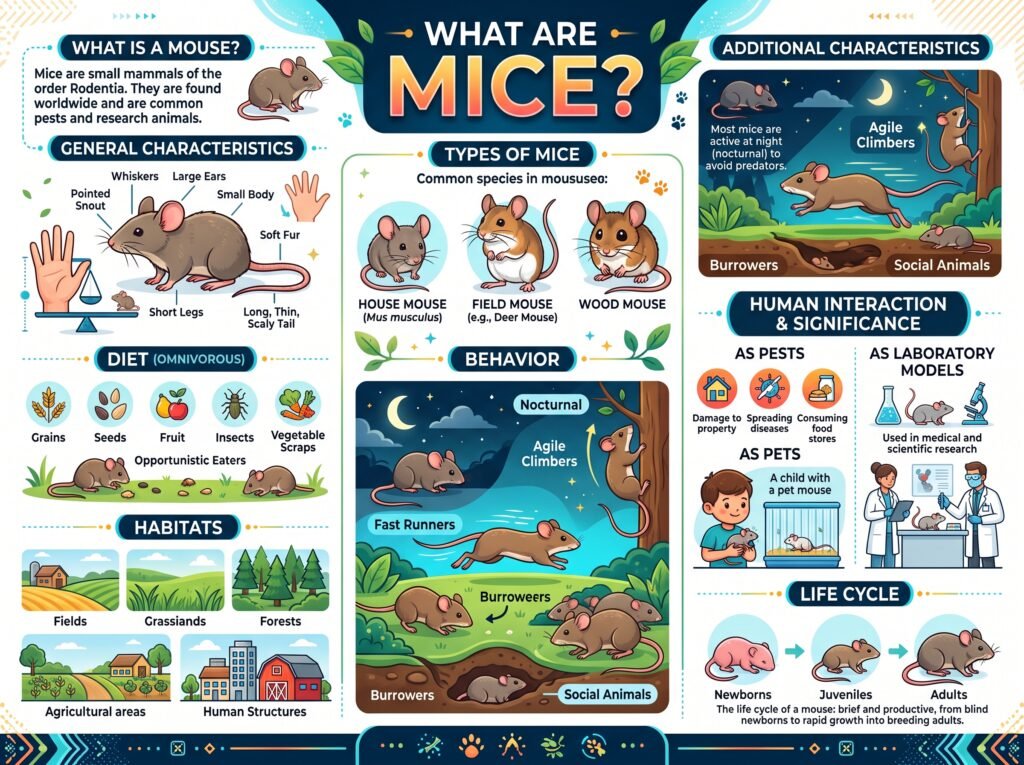
A mouse is a small, fast-breeding rodent, and in Canadian homes, the species almost always responsible is the house mouse (Mus musculus). House mice are small and slender, typically weighing 12 to 30 grams and measuring 6 to 9 cm from nose to the base of the tail, with a tail nearly as long as the body itself. Their fur ranges from dusty grey to light brown, sometimes darker, with a lighter, cream-coloured belly, large ears, a pointed snout, and small eyes.
In our experience, most homeowners assume any mouse in their home is a “field mouse” that wandered in by accident. In reality, the house mouse has been living alongside humans for thousands of years, and once inside, it has no particular interest in going back outdoors. It’s built to thrive indoors, with a steady food source, warmth, and shelter from predators.
Types of Mice: House Mouse, Deer Mouse, and Field Mouse
Not every mouse found near a Canadian home is the same species, and the differences matter more than most homeowners realize.
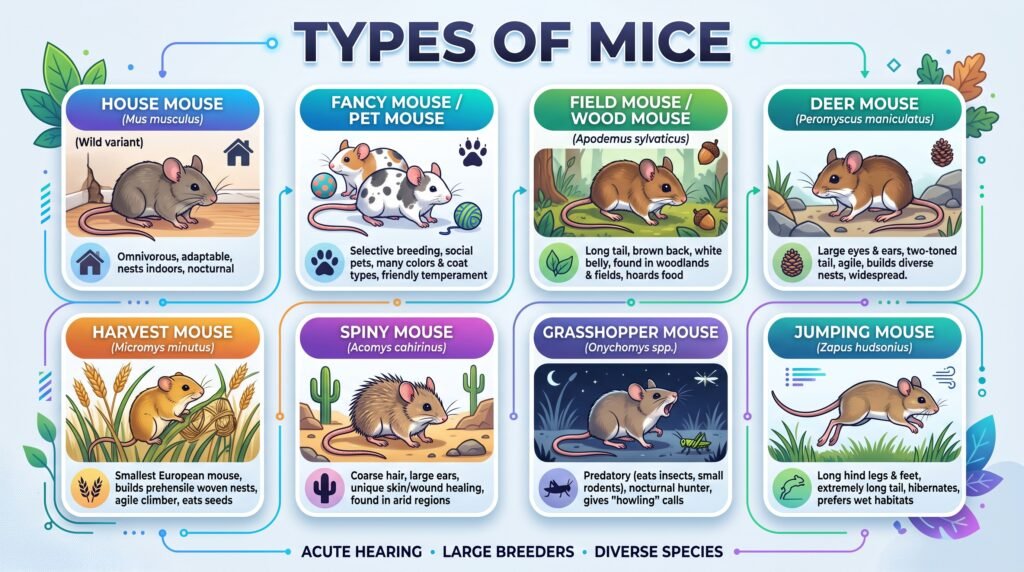
- House mouse (Mus musculus) – The species responsible for the overwhelming majority of indoor infestations. Uniformly grey to brown fur with a lighter belly, less colour contrast than other species, and a musky odour where it nests or travels regularly.
- Deer mouse (Peromyscus maniculatus) – Found throughout Canada, more common in rural and semi-rural areas. Distinctly bicoloured, with a white belly and underside contrasting against a brown or grey back and tail, and noticeably larger eyes and ears than a house mouse.
- Field mouse (vole) – Often used as a general term for mice living outdoors in fields and grassy areas, typically with a two-toned coat and a shorter tail relative to body length than a house mouse.
The distinction between a house mouse and a deer mouse isn’t just academic. Deer mice are the primary carrier of the hantavirus strain responsible for hantavirus pulmonary syndrome in North America, while house mice carry a considerably lower risk. This is exactly why correctly identifying which species you’re dealing with matters before any cleanup begins.
Mice vs. Rats: Are They the Same?
No. Mice and rats are related rodents, but they’re distinct species with different behaviour. The Norway rat, the species most commonly found in Canadian cities, is significantly larger than a house mouse, with a thicker body, blunter snout, and smaller ears relative to its head. Mice are also considerably more curious and willing to explore new objects in their environment, while rats tend to be more cautious around anything unfamiliar. This difference affects everything from where each species nests to how a technician approaches trapping and exclusion.
Where Do Mice Live? Habitat
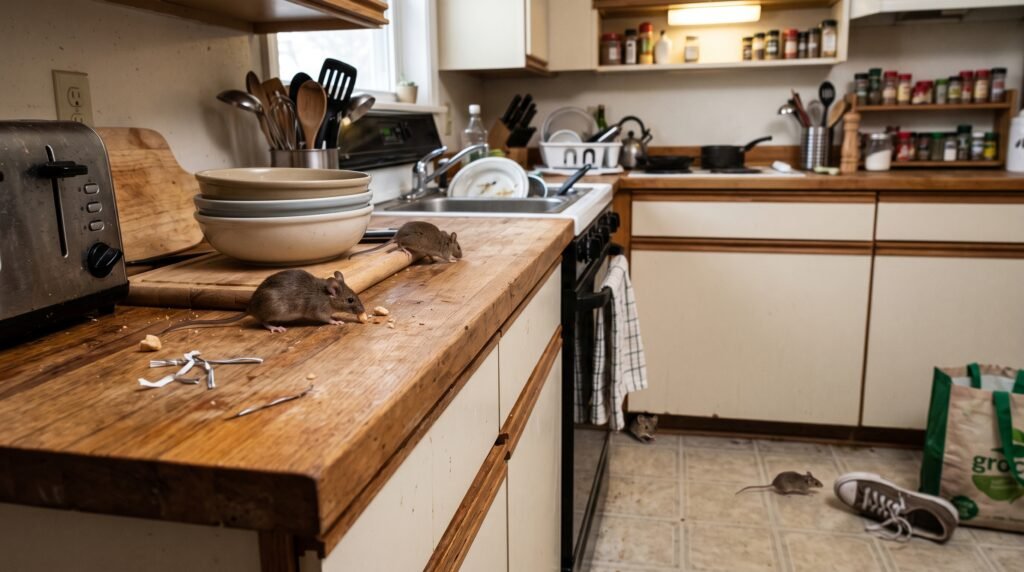
House mice look for secluded, sheltered areas close to food and water. Common hiding spots we check during an inspection include:
- Wall voids, particularly near kitchens and areas with plumbing
- Attics and insulation, especially where it’s undisturbed
- Basements, crawl spaces, and storage rooms
- Behind and beneath appliances like stoves and refrigerators
- Inside cluttered closets, cardboard boxes, and storage bins
- Voids behind cabinets and inside drop ceilings
Mice build nests from soft, shredded material, including paper, fabric, and insulation, usually tucked into the most undisturbed corner of whatever space they’ve claimed. One thing we notice on inspections is how often a nest turns up somewhere a homeowner rarely goes, like behind stored holiday decorations or inside an unused kitchen drawer, simply because mice actively seek out locations with minimal disturbance.
What Do Mice Eat? A Mouse's Favourite Food
Mice are omnivores, though they show a strong preference for certain foods. Grains, seeds, and cereals are typically their favourite, but they’ll readily eat:
- Pet food left out overnight
- Crumbs, food scraps, and improperly stored pantry items
- Fruits, vegetables, and nuts
- Insects, when other food is scarce
- Non-food items like soap, glue, and cardboard, particularly when nesting material is needed
Mice need very little food and water to survive, which is part of why an infestation can persist even in a home that seems reasonably clean. Our technicians usually discover that homeowners are surprised by how small the food source actually was, sometimes nothing more than a bag of birdseed in the garage or a forgotten box of crackers in a pantry corner.
Mouse Life Cycle and Reproduction
The house mouse’s reproductive rate is exactly why a small mouse problem escalates so quickly. After a gestation period of about 19 to 21 days, a female gives birth to a litter of roughly five to six pups, though litters can occasionally be larger. Newborn pups are hairless, blind, and completely dependent on their mother, with fur appearing around day six and eyes opening around days 13 to 14.
Mice reach sexual maturity remarkably fast, typically within four to six weeks of birth, and females can become pregnant again within 24 hours of giving birth due to a reproductive phenomenon called postpartum estrus. Unlike many animals, house mice don’t have a defined breeding season indoors; a warm, climate-controlled home lets them breed essentially year-round. A single female can produce up to ten litters annually under favourable conditions, which means a single pregnant mouse getting into a home in early fall can realistically leave behind dozens of descendants by spring.
Mouse Behaviour and Seasonal Activity
House mice are naturally curious and will investigate anything new or unfamiliar in their territory, a trait that pest control technicians rely on when placing traps in the right locations. They’re also primarily nocturnal, most active at night, which is exactly why homeowners so often hear scratching or scurrying sounds after dark rather than seeing mice directly during the day.
This changes considerably with the season. Mice don’t hibernate, and as outdoor temperatures drop in the fall, they actively search for warmer shelter, which is why we see a sharp increase in calls between September and November. Once mice establish themselves indoors with a reliable food source, activity can continue steadily through winter regardless of what’s happening outside.
Signs of a Mouse Infestation
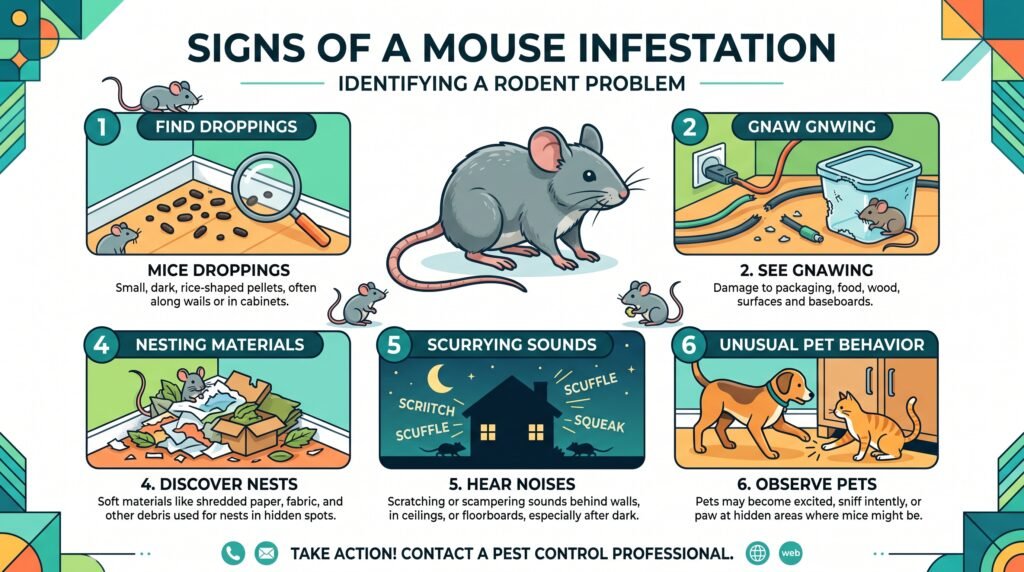
Because mice are nocturnal and cautious, most homeowners rely on physical evidence rather than actual sightings to confirm an infestation:
- Droppings that are small, dark, rod-shaped, and pointed at both ends, typically found along walls, in drawers, or near food sources
- Gnaw marks on food packaging, wiring, baseboards, or furniture
- Greasy rub marks along baseboards and walls where mice travel repeatedly
- Scratching or scurrying sounds, particularly at night, coming from walls, ceilings, or attic spaces
- A musky, ammonia-like odour in areas with heavy activity
- Nests made from shredded paper, fabric, or insulation tucked into undisturbed corners
One mistake we see repeatedly is a homeowner spotting a single mouse and assuming it’s an isolated incident. Because house mice reproduce so quickly, seeing even one during the day, when they’re normally hiding, often means the population behind the walls is considerably larger than what’s visible.
Are Mice Harmful to Humans? Health Risks
Mice pose several genuine health risks, primarily related to contamination rather than direct injury. Their droppings and urine can carry bacteria, including salmonella, and contamination of food or surfaces can lead to illness if exposed food is consumed. Dust containing dried mouse droppings can also trigger allergic reactions or worsen asthma symptoms, particularly in children, when disturbed and inhaled.
The more serious health concern connects specifically to deer mice rather than the common house mouse. Deer mice are the primary reservoir in Canada for Sin Nombre virus, the hantavirus strain responsible for hantavirus pulmonary syndrome, a rare but serious respiratory illness.
Health authorities note that people are most often exposed when virus particles from dried droppings, urine, or nesting material become airborne and are inhaled, which is why cleaning up rodent activity, particularly in cottages, sheds, or vacant spaces where deer mice may have been active, requires care rather than simply sweeping or vacuuming the area.
If you’re cleaning up a suspected deer mouse nest, ventilating the space first and using a damp cleaning approach rather than a dry sweep is a safer method, and health authorities recommend wearing gloves throughout.
Mice can also cause structural and fire hazards through gnawing behaviour, since they chew on wiring, insulation, and building materials both to wear down their continuously growing teeth and to gather nesting material.
Mice and Fleas
Mice, along with other wildlife, can carry fleas directly into a home, particularly if a rodent has been denning in an attic, wall void, or crawl space for an extended period. This is one of the reasons a rodent infestation and an unexplained flea problem sometimes appear together, and it’s worth mentioning to a technician if you’re dealing with both at once, since addressing the rodents without treating the fleas left behind can lead to a lingering secondary problem.
How to Prevent Mice
Prevention comes down to closing off access and removing the food and shelter mice depend on:
- Seal gaps around pipes, vents, and utility penetrations; mice can squeeze through openings as small as 6 mm, about the width of a pencil
- Store food, including pet food and birdseed, in airtight containers rather than original bags
- Keep garages, sheds, and basements decluttered, since piles of boxes and stored items make ideal nesting spots
- Trim vegetation and remove woodpiles away from the foundation, which can serve as a bridge into the home
- Repair damaged weatherstripping and door sweeps, particularly on garage and exterior doors
- Address entry points before fall, when mice are actively searching for winter shelter
We’ve found that exclusion, physically sealing the ways mice get in, produces far more lasting results than trapping alone. Removing mice without closing their entry points just means new ones move in behind them.
Mice in Apartments and Multi-Unit Buildings
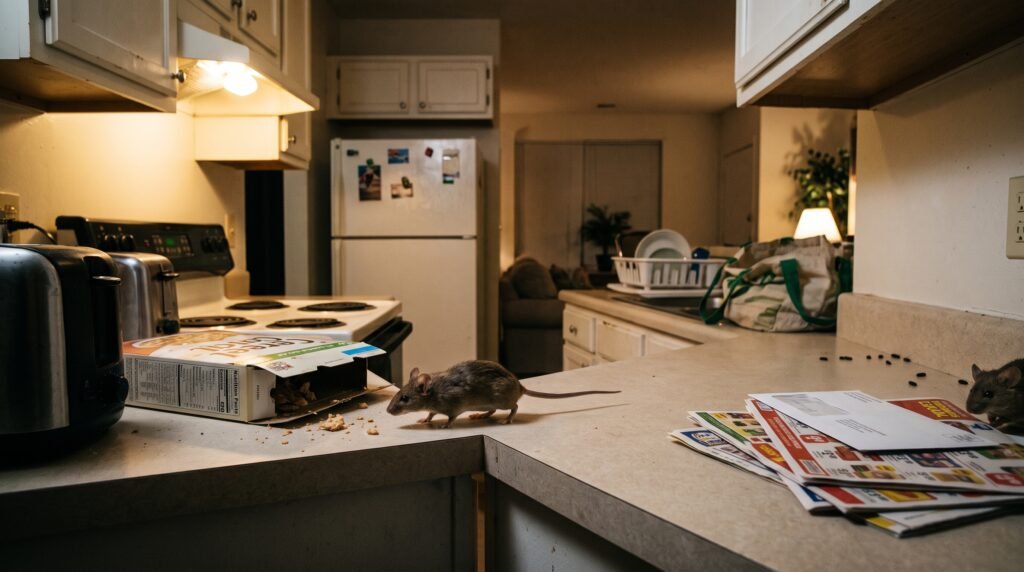
Mice behave differently in shared buildings than in a detached home, which is worth understanding if you live in an apartment or condo anywhere in the GTA. Because mice travel through wall voids, plumbing chases, and shared utility spaces, a population in one unit can spread to neighbouring apartments even when those units are kept clean and clutter-free. Treating a single suite in isolation often produces limited results, since mice simply retreat to an adjacent unit during treatment and return once activity settles down.
If you live in a rental and notice signs of mice, reporting it to building management early tends to lead to a faster, more coordinated response than handling it unit by unit. Older buildings throughout Toronto, in particular, often have gaps around plumbing risers and shared walls that give mice an easy path between suites.
Safe Cleanup of Mouse Droppings and Nests
Because deer mice specifically carry a hantavirus risk, cleanup approach matters, particularly in cottages, sheds, garages, or any space that’s sat closed up for a while. Health authorities recommend avoiding dry sweeping or vacuuming droppings directly, since this can send contaminated dust into the air.
Instead, ventilate the space for a period before starting, wear gloves, and use a damp cloth or a diluted bleach solution to clean the area rather than dry methods. This precaution matters most in rural and semi-rural settings where deer mice are more common; the risk from typical house mouse droppings in an urban home is considerably lower, though basic hygiene, gloves and thorough handwashing, is still worth following regardless of species.
How to Get Rid of Mice

Snap traps : A reliable, immediate method for actively removing mice, best placed along walls and travel routes identified during an inspection, since mice tend to follow the same paths repeatedly.
Live traps : Capture mice without killing them, though they require regular checking and a plan for release well away from the home, since mice released nearby will often attempt to return.
Bait stations : Tamper-resistant stations containing rodenticide are typically used by professionals in situations where trapping alone isn’t managing a larger population, always placed with care around children and pets.
Rodent exclusion : Physically sealing entry points with materials mice can’t chew through, such as steel wool combined with sealant or metal flashing, addresses the root of the problem rather than just the visible population
Professional Mouse Removal
A proper mouse inspection identifies not just where mice are currently active, but how they’re getting in and where they’re likely to establish new nests if the first population is removed. Our pest control services combine trapping, targeted exclusion work to seal entry points, and follow-up visits to confirm activity has actually stopped rather than just quieted down temporarily.
If you’re noticing rodent activity alongside signs of another pest, such as an unexplained flea problem or activity that suggests wildlife denning nearby, it’s worth having a broader home and wildlife inspection done at the same time, since these issues often overlap in older GTA homes with existing gaps or moisture problems.
Frequently Asked Questions
Are mice the same as rats?
No. Mice and rats are related but distinct species. Mice are smaller, more curious, and quicker to explore new objects, while rats, particularly the Norway rat, are larger, more cautious, and require different trapping and exclusion approaches.
What is a mouse's favourite food?
Grains, seeds, and cereals are typically preferred, though house mice are opportunistic and will eat crumbs, pet food, fruit, and even non-food items like cardboard when gathering nesting material.
How do I get rid of mice in my house?
Combine active trapping with sealing entry points, since mice can squeeze through gaps as small as 6 mm. Removing mice without addressing how they got in typically leads to new mice returning within weeks