

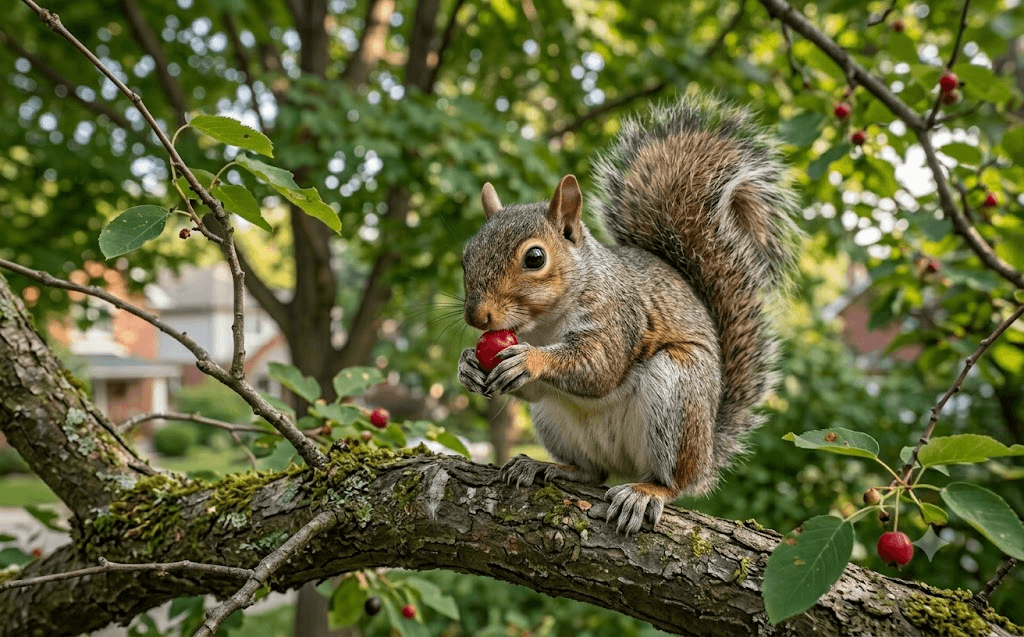
It’s one of the first questions I ask when a homeowner calls me. Not “do you have squirrels?” that’s usually already established. I ask: “Where exactly are they living?” Because in twenty years of wildlife removal work across Toronto and the Greater Toronto Area, I’ve learned that squirrel habitat is far more complex than most people realise. These animals don’t just live in trees. They live in attics, in wall cavities, in chimney chases, and in the soffits of homes in Scarborough, Brampton, Mississauga, and Vaughan often just metres from where families are sleeping.
Understanding where squirrels live, and why they choose the habitats they do, is the foundation of any effective squirrel control strategy. So let me walk you through everything I know about squirrel habitat from boreal forests to your insulation
Quick answer: Squirrels live in three primary habitats depending on species, tree canopies (eastern gray and red squirrels), underground burrows (ground squirrels and chipmunks), and tree cavities or communal nests (flying squirrels). In the GTA, the most common attic intruders are eastern gray squirrels and red squirrels, with flying squirrels being the most frequently overlooked. All three species will readily move into human structures when natural habitat is nearby.
Where do squirrels live in the wild?

Squirrels are arguably the most habitat-adaptable mammals on the planet. Members of the family Sciuridae within the order Rodentia, they live on every continent except Australia and Antarctica from tropical rainforests to semiarid desert, from sea level to mountain meadows. The only zones they consistently avoid are the high polar regions and the most extreme deserts, where food scarcity makes survival impossible year-round.
In Ontario and across Canada’s temperate zone, squirrel habitat centres on three core environments, each matched to a different type of squirrel. Understanding which species you’re dealing with tells you immediately where they’re living and by extension, where they’re likely to enter your home.
Tree squirrels — the arboreal specialists
Tree squirrels are arboreal animals, meaning they spend the majority of their lives above ground. In Ontario, the two species that matter most for GTA homeowners are the eastern gray squirrel (Sciurus carolinensis) and the red squirrel (Tamiasciurus hudsonicus).
In natural settings, gray squirrels thrive in mature or nearly mature deciduous forest particularly stands dominated by oak, hickory, walnut, maple, and elm trees, where at least 50 to 75 per cent of the canopy is composed of nut-bearing trees. That food supply is everything. The density of a gray squirrel population in any given area tracks almost exactly with the density of mast-producing trees.
Red squirrels prefer coniferous forest spruce, pine, and fir stands are their comfort zone. They’re more common in the semi-rural pockets north and east of the GTA, in areas like the outskirts of Pickering and Ajax where residential neighbourhoods back onto greenbelt and woodland. Red squirrels are noticeably more territorial and vocal than their gray cousins, and their presence in your neighbourhood is usually announced before you ever see one.
Both species build dreys the nest type most people associate with squirrels. A drey is a roughly spherical structure built in the fork of a tree branch, typically at least six metres off the ground. The outer shell is woven from sticks and twigs, the interior is hollow and roughly 20 centimetres in diameter, and the lining is made from soft materials: leaves, grass, moss, shredded bark, and whatever else the squirrel can carry. Dreys provide excellent insulation critical for an Ontario winter, but they’re also notoriously hard to spot in summer when leaves are full. They become visible in November, when the canopy drops.
Flying squirrels — the nocturnal cavity nesters
Flying squirrels are the species I most frequently underdiagnose early in my career and they’re the one that most often surprises GTA homeowners. Ontario has two flying squirrel species: the northern flying squirrel and the southern flying squirrel. Unlike tree squirrels, they’re nocturnal, moving silently through the canopy after dark using their patagium the elastic gliding membrane stretched between their front and hind limbs to glide distances of up to 45 metres between trees.
Flying squirrels are cavity nesters. In the wild, they den exclusively in hollowed trees, abandoned woodpecker holes, and natural tree cavities lined with soft materials like shredded bark, moss, lichen, and feathers. They’re also intensely social unlike the largely solitary gray squirrel, flying squirrels form communal colonies of 10 to 20 or more individuals, huddling together in shared cavities for warmth through the winter.
I once opened an attic hatch in a home in Vaughan the homeowner had been calling exterminators for mice for two years and found 18 southern flying squirrels in a single nest cluster near the ridge board. The family had zero idea. Flying squirrels enter through tiny gaps, move silently, and weigh so little that their footsteps are often mistaken for mice. If you’re hearing soft, rapid movement at night and your exterminator keeps coming up empty on mice, strongly consider flying squirrels.
Ground squirrels and chipmunks — the burrowing species
Ground squirrels and their close relatives, chipmunks (Tamias striatus), prairie dogs, marmots, and woodchucks are fossorial animals that live primarily underground. In Ontario, the eastern chipmunk is by far the most common burrowing member of the Sciuridae family you’ll encounter in the GTA.
Chipmunk burrows are surprisingly extensive. A single system can extend 1 to 3 metres underground and include multiple chambers, one for sleeping, one or more for food storage, and separate latrine areas. Burrow entrances are typically 4 to 5 centimetres in diameter and remarkably neat: chipmunks carry the excavated soil away in their cheek pouches and scatter it at a distance, leaving the entrance hole without a telltale dirt mound. This is one reason homeowners often miss chipmunk burrows until they’ve been present for a full season.
Unlike tree squirrels, ground squirrels and chipmunks are true hibernators. They enter a deep state of hibernation in autumn, their body temperature dropping close to ambient levels, and they don’t emerge until early spring. They survive winter on food caches stored in their burrow chambers, not on body fat like raccoons do. This is why a chipmunk’s midden (food cache) is so central to its survival, and why it defends its territory so aggressively in late summer and fall.
Where do squirrels nest? Understanding the drey
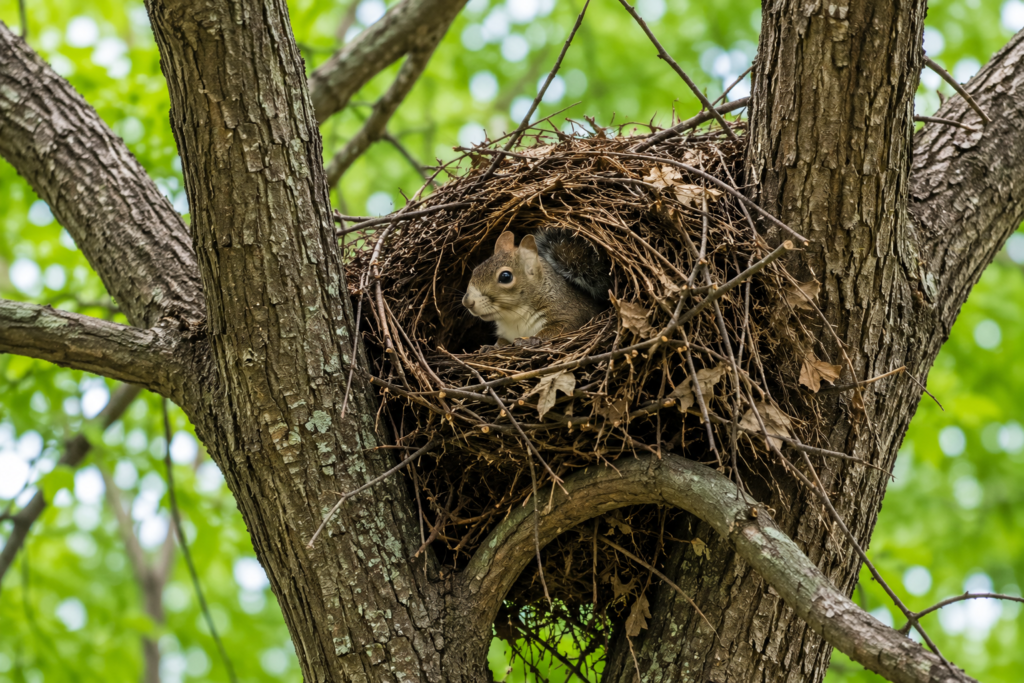
The drey is the signature habitat structure of Ontario’s tree squirrels, and understanding how they build and use it tells you a great deal about squirrel behaviour, including why your attic is such an appealing alternative.
Gray squirrels typically maintain two types of dreys. The summer drey is a looser, more open structure built in the canopy cooler and better ventilated during the humid GTA summers. The winter drey is denser, more insulated, and often placed lower in the tree or inside a tree cavity, providing warmth during Ontario’s cold months. Both are roughly football-sized from the outside. The interior is hollow and surprisingly tight, only one or two squirrels fit comfortably.
Squirrels build dreys at forks where multiple branches meet, choosing spots that provide natural structural support. They prefer locations where the overhanging canopy provides some rain protection. A well-built drey in a mature red maple or oak, the kind of tree common across North York, Etobicoke, and the older residential areas of Scarborough, will be used and maintained for multiple seasons, sometimes by multiple generations.
Field observation: Gray squirrels often maintain three or four dreys within their home territory simultaneously, rotating between them based on season, weather, and perceived threat level. When one drey is disturbed, say, by a tree being pruned the squirrel doesn’t simply find a new spot in the woods. It explores alternatives. If your roofline is accessible and offers a gap into your attic, that becomes candidate number one.
Where do squirrels live in your home? The GTA attic reality
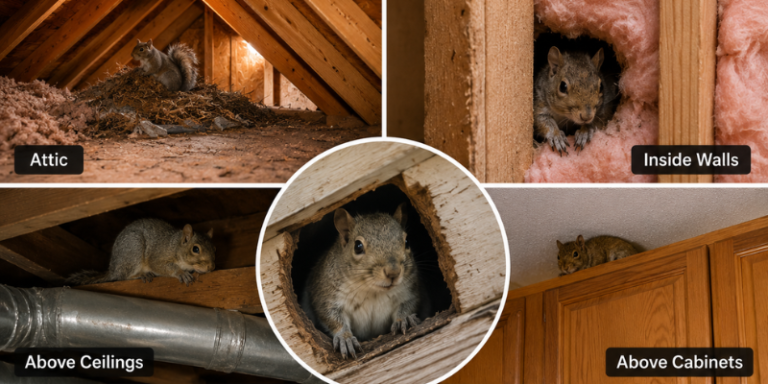
This is where the biology gets personal. The same instinct that drives a squirrel to build a drey in a tree cavity drives it to explore a gap in your fascia board. Your attic offers everything a drey provides, plus more: consistent temperature, protection from predators, soft insulation material for nest-building, and proximity to the established food sources the squirrel has already mapped in your neighbourhood.
In twenty years of inspections across the GTA, I’ve found squirrels in every conceivable part of a home’s structure. But the pattern is not random. Different species tend to occupy different zones:
| Species | Typical location in home | How to identify |
|---|---|---|
| Eastern gray squirrel | Attic insulation, soffit voids, behind fascia boards | Daytime noise (7–9 a.m., 4–6 p.m.), debris in eavestroughs |
| Red squirrel | Attic, often near ridge board; creates large middens | Loud chattering, pine cone husks or acorn debris in attic |
| Northern flying squirrel | Attic cavity near ridge or gable end, communal cluster | Soft, rapid movement after dark; no noise during day |
| Eastern chipmunk | Crawlspace, basement wall cavity, under concrete steps | Ground-level entry point; chattering near foundation |
The most important diagnostic for homeowners is timing. Gray and red squirrels are diurnal, you will hear them most intensely during the first two hours after sunrise and again in the two hours before sunset. If the noise in your attic happens at those times, you’re almost certainly dealing with tree squirrels. Flying squirrel noise occurs at night. Raccoon noise, often confused with squirrels, is heavier, less rapid, and tends to occur between 10 p.m. and 3 a.m. This distinction alone saves a significant amount of diagnostic time when our team at Wildlife Removal Toronto arrives at a job.
Where do squirrels sleep in winter? Ontario's seasonal habitat shift
One of the most common misconceptions I hear from GTA homeowners is that squirrels hibernate. They don’t, not gray squirrels, and not red squirrels. What they do instead is enter a state of torpor: an energy-conserving deep rest from which they wake periodically during mild weather to forage. They are not sleeping for five months straight. They’re resting, but alert, and they move when conditions allow.
To survive an Ontario winter, gray squirrels spend September through November in an intensive period of scatter hoarding, burying individual nuts and seeds across their territory in thousands of separate small caches. Each cache is typically only a few centimetres underground, covered with leaf litter. The squirrel relocates these caches using a combination of spatial memory and olfactory cues (scent, not the visual memory of where they buried things). The caches it doesn’t recover, forgotten or abandoned, often germinate in spring, making squirrels one of the most important agents of seed dispersal in Ontario’s hardwood forests.
Red squirrels operate differently. Rather than scatter hoarding, they build a midden, a centralised food cache, often enormous, sometimes covering several square metres. I’ve found red squirrel middens inside attics in Markham that filled entire corners of the space with pine cone remnants, acorn husks, and fungi. One particular job near the Rouge River valley took two full days to clean out. The midden had been accumulating for at least three seasons.
Flying squirrels handle winter communally. Their colonies huddle together in shared tree cavities or attic spaces, sharing body heat to survive the coldest nights. They don’t scatter hoard like gray squirrels, they store food in or near their communal nest and forage on mild nights throughout the winter.
| Species | Winter strategy | Winter habitat |
|---|---|---|
| Eastern gray squirrel | Torpor + scatter hoarding | Dense winter drey or tree cavity; attic in urban areas |
| Red squirrel | Torpor + midden cache | Tree cavity or attic near midden |
| Northern flying squirrel | Communal torpor | Shared tree cavity or attic; colony of 10–20 |
| Eastern chipmunk | True hibernation | Underground burrow with food cache |
Squirrel habitat in the GTA: why Toronto has some of Canada's highest squirrel density
Here’s something most people don’t know: Toronto and its surrounding GTA municipalities support some of the highest urban squirrel population densities in the country. The reason is straightforward once you understand squirrel ecology.
The GTA’s older residential neighbourhoods, the mature tree-lined streets of The Annex, Leaside, Rosedale, Forest Hill, and comparable areas in Mississauga‘s older cores, were planted with hardwood trees 60 to 100 years ago. Those trees are now in full maturity, producing abundant mast (acorns, nuts, seeds) every year. The GTA also has remarkably consistent food availability year-round: green bin organic waste, bird feeders, garden vegetables, and pet food left outdoors all supplement natural food supplies. And the built environment, thousands of aging homes with gaps in soffits, fascia boards, and roof edges, provides denning habitat that rivals or exceeds what a natural forest offers.
The result is an urban squirrel population that reproduces at higher rates, survives at higher rates, and has less incentive to disperse than rural populations. That concentrated population means more pressure on every home in a given neighbourhood. The family of gray squirrels living in your attic in North York isn’t there because you did something wrong. They’re there because your neighbourhood is extraordinarily good squirrel habitat.
How squirrels find and enter your home
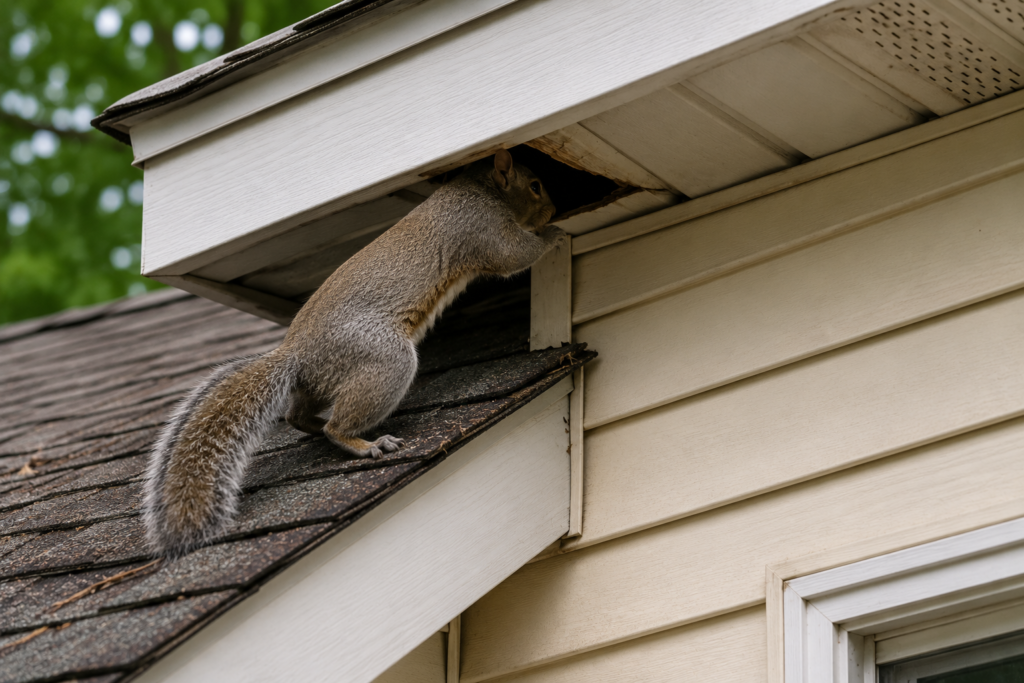
Understanding where squirrels live also means understanding how they transition from the tree canopy to your attic. It’s not random. Squirrels follow predictable access routes driven by their physical capabilities and their persistent exploration of every structural edge in their territory.
Tree squirrels can jump roughly 2 metres horizontally and can descend tree trunks headfirst by rotating their ankles 180 degrees to grip the bark in reverse. Any tree branch within 2 to 3 metres of your roofline is a potential launch point. From the roofline, they probe every edge: the fascia-soffit junction, plumbing stack caps, ridge vents, gable vents, and the corner caps where two roof planes meet.
The most common entry points I find across GTA homes: Damaged or rotted soffit panels (especially on the north-facing sides of homes, where moisture damage accumulates fastest). Plastic plumbing vent caps, gray squirrel incisors chew through standard plastic in under ten minutes. Gable vents with deteriorated mesh or missing hardware cloth. Roof-wall junctions on dormers and additions where flashing has lifted. And uncapped chimneys, which are particularly attractive to flying squirrels entering silently at night.
What makes this particularly challenging is that squirrels remember successful access routes for years. Research has documented that squirrels can retain the solution to a task for up to three years. A squirrel that found a gap in your soffit in 2023 still knows that route in 2026, and her offspring, whom she taught to forage alongside her, know it too. Multi-generational use of the same home entry point is not uncommon.
At Wildlife Removal Toronto, we’ve documented the same attic access point being used across four consecutive seasons, with each wave of animals being a successive generation of the original family.
When squirrel habitat shifts into your home: the seasonal pattern
Squirrel intrusions in GTA homes follow a consistent seasonal rhythm tied to the species’ reproductive cycle and Ontario’s climate. Understanding this pattern helps homeowners know when to be proactive.
| Period | Squirrel activity | Home intrusion risk |
|---|---|---|
| January – February | First breeding season; males actively seeking females | High — new entries explored during mild spells |
| March – April | Pregnant females seeking nest sites; kits born late March | Very high — attic ideal nest site for litter-rearing |
| May – July | Kits are growing rapidly; family active in den | High — structural damage peaks; noise obvious |
| August – September | Second breeding season; juveniles dispersing | High — new juveniles seeking first territory |
| October – November | Intensive food caching; winter den-seeking | Very high — peak entry period across GTA |
| December | Settled in winter dens; less active | Moderate — existing infestations remain active |
The fall pressure window October and November, is consistently the busiest period we see at Wildlife Removal Toronto. Juvenile squirrels born in the summer litter are now fully grown but without an established territory. They’re exploring every neighbourhood in the GTA simultaneously, testing every accessible roof edge and soffit gap. A home that was squirrel-free in September can have an established intruder by early November if any structural vulnerability exists.
Where do squirrels live in winter in Ontario?
Gray and red squirrels remain active through Ontario winters, sheltering in dreys or tree cavities during the coldest periods and foraging during mild spells. In the GTA, many urban gray squirrels shift their winter habitat into attics and soffits, where temperatures are more stable than any outdoor structure. Flying squirrels huddle communally in tree cavities or attics through winter. Eastern chipmunks are the exception, they genuinely hibernate underground in their burrow chambers, emerging in late March or early April
Where do squirrels build their nests?
Tree squirrels build dreys, spherical nests of twigs, leaves, and soft materials, in the forks of tree branches at least 6 metres above ground. They also use tree cavities, particularly hollow sections where limbs have broken off or abandoned woodpecker holes. In urban environments, when natural sites are close to homes with accessible gaps, they readily nest in attics, wall cavities, and soffit voids. Flying squirrels nest exclusively in cavities, natural or man-made and do so communally. Ground squirrels and chipmunks nest underground in multi-chamber burrow systems.
How far do squirrels travel from where they live?
Gray squirrels maintain a home territory of 0.5 to 2 hectares depending on food availability. In dense urban environments like central Toronto, where food is abundant and concentrated, territories are smaller, sometimes as little as a city block. Red squirrels are more territorial and maintain smaller but more aggressively defended ranges. A squirrel living in your attic is likely foraging within a radius of 200 to 400 metres of your home. That’s one reason that relocating a trapped squirrel less than 2 kilometres away almost always results in the animal returning. The Ontario Wildlife Act recognises this limitation and effectively discourages relocation as a primary strategy