

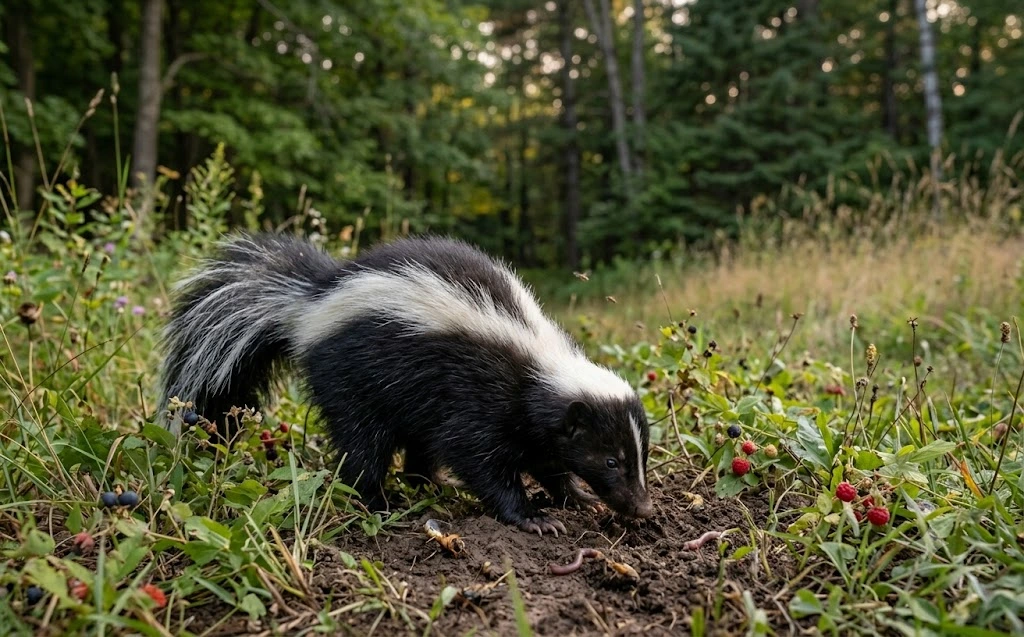
Skunks are highly adaptable omnivorous animals that consume both animal-based protein and plant matter. In their natural wild habitat, their diet consists primarily of insects, soil grubs, small rodents, wild berries, and bird eggs. In urban areas like Toronto, they easily adjust by scavenging through unsecured residential garbage, compost piles, outdoor pet food, and manicured lawns. Their feeding habits are nocturnal, opportunistic, and change heavily based on seasonal availability across Canada.
What Do Skunks Really Eat in the Wild?
In natural environments across Ontario and Western Canada, skunks are best described as highly opportunistic omnivores. They do not possess a fixed or rigid diet; instead, their daily food intake shifts fluidly based on what their immediate ecosystem provides.
The vast majority of a wild skunk’s natural food sources are ground-based. Equipped with long, sharp claws and an incredibly acute sense of smell, skunks spend hours slowly walking through fields and forest edges sniffing out hidden food. Their absolute primary preference is ground-dwelling insects. They actively seek out grasshoppers, crickets, beetles, and earthworm, especially after a heavy rainfall when the damp soil becomes easier to navigate.
Beyond insects, wild skunks act as vital scavengers and minor predators within the Canadian ecosystem. They will readily hunt and consume small vertebrates such as field mice, voles, frogs, and lizards. If they happen across a ground-nesting bird, they will not hesitate to consume the bird eggs as well. When animal-based proteins become scarce during the peak summer heat, they balance their nutritional intake by eating wild berries, plant roots, and fallen nuts.
From field experience dealing with local wildlife, skunks living in rural zones or near the semi-natural greenbelt edges of the GTA typically exhibit a very balanced, highly protein-rich body condition. These animals are naturally leaner and spend their energy pacing through large territories to satisfy their foraging instincts.
Why Skunks Only Eat at Night (Behavior Linked to Diet)
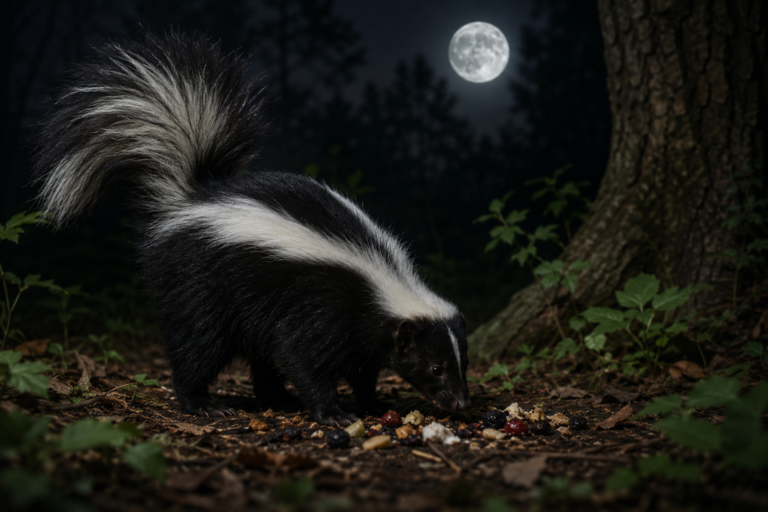
Skunks are strictly nocturnal mammals, which means their entire biological clock and feeding routine revolve around the nighttime hours. This behavioral adaptation is a highly calculated survival strategy directly tied to how and when they source their food.
Foraging under the cover of darkness provides skunks with a massive advantage in urban and suburban landscapes. At night, human activity drops to zero, and large natural predators are far less visible. This gives the slow-moving skunk a stress-free environment to look for food. Furthermore, many of their favorite food source, such as earthworms, nocturnal beetles, and lawn grubs, naturally migrate closer to the surface of the soil during the cool, damp night hours, making them effortless to detect.
In residential areas across the Greater Toronto Area, our team at Wildlife Removal Toronto consistently observes that local skunk activity peaks dramatically between midnight and 3:00 AM. Because of this nocturnal timeline, property owners rarely see the animals face-to-face. Instead, they wake up to the unmistakable calling cards left behind on their properties: faint skunk odors hanging in the morning air or characteristic fresh digging patches scattered across their grass.
What Do Urban Skunks Eat in Cities Like Toronto?
Urban expansion has completely transformed how wildlife interacts with the environment, and the striped skunk is one of the most successful urban adapters in North America. When a skunk moves away from the forest and enters dense residential zones like Toronto, Scarborough, or Mississauga, its diet shifts from wild foraging to active urban scavenging.
In the city, human-related food waste quickly becomes the skunk’s primary energy source. Our poorly secured green organic bins and standard garbage bags are an absolute goldmine for them. Skunks have remarkably strong, dexterous front paws that allow them to rip through plastic bags or knock over unsecured bins to access leftovers like meat scraps, discarded fruits, and cooked starches.
Residential backyards also present an artificial paradise for a hungry skunk. Fallen fruit from backyard apple or cherry trees, spilled seeds scattered underneath bird feeders, and open compost piles offer endless, effortless calories.
Through twenty years of field operations at Wildlife Removal Toronto, a clear rule has emerged: skunks do not settle near your home because they like the architecture; they settle because your property provides an active, reliable food buffet. If you have an open crawlspace but zero food nearby, a skunk will likely move on. But if your backyard features a regular supply of accessible food, they will quickly seek out permanent shelter beneath your decks or garden sheds.
The Most Common Skunk Food Source Homeowners Don’t Notice
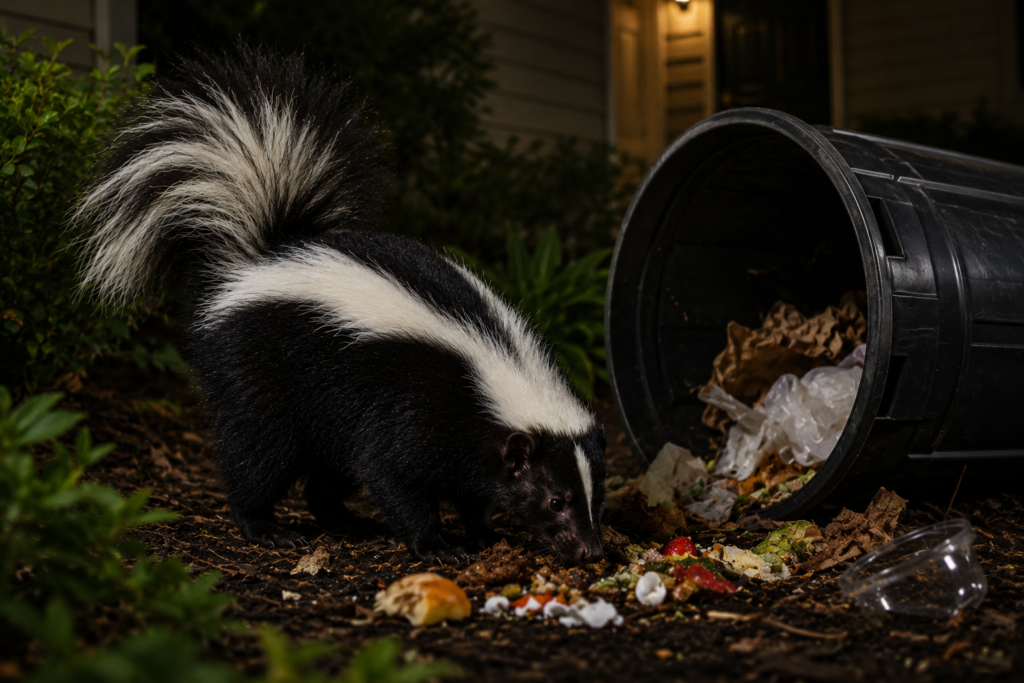
There is one massive urban food source that draws skunks onto pristine suburban lawns more than anything else: lawn grubs. These are the subterranean larvae of June bugs, Japanese beetles, and European chafers that live just below the grass roots, feeding on your lawn’s moisture.
To a skunk, a grub-infested lawn is essentially an all-you-can-eat protein bar. Using their highly refined sense of smell, a skunk can pinpoint the exact location of a single grub moving beneath the turf. They will press their nose to the ground, dig a neat, cone-shaped hole about three to four inches deep, pull the grub out, and move on to the next spot.
When homeowners wake up to find dozens of these small, circular holes punched holes across their manicured front yards, they often mistake it for random, malicious property destruction. In reality, it is a highly targeted, precise feeding pattern.
During our initial property inspections at Wildlife Removal Toronto, we frequently have to explain that a sudden spike in skunk visits is actually a symptom of a larger lawn pest problem. If your soil is crawling with grubs, skunks will bypass all human deterrents to get to them. While this digging can be incredibly frustrating for a homeowner trying to maintain a perfect garden, it is worth noting that skunks act as a natural pest control system, keeping destructive beetle populations in check.
How Skunk Diet Changes With Seasons in Canada
Spring Season
Primary Food Sources: Earthworms, emerging grubs, and small mice.
Local Homeowner Risk Level: HIGH (Skunks are actively seeking nesting sites under decks and sheds).
Summer Season
Primary Food Sources: Wild berries, ground insects, and accessible bird eggs.
Local Homeowner Risk Level: MEDIUM (High activity levels, but focused on active backyard foraging).
Fall Season
Primary Food Sources: High-calorie scavenging, fallen fruits, and residential garbage.
Local Homeowner Risk Level: HIGH (Hyperphagia phase as they aggressively prepare for winter).
Winter Season
Primary Food Sources: Relying on stored body fat with rare, emergency scavenging.
Local Homeowner Risk Level: LOW (Animals enter a torpor state with minimal outside movement).
Are Skunks Omnivores or Carnivores?
From a scientific classification standpoint, skunks are definitive true omnivores. Their digestive systems are perfectly evolved to process both complex animal proteins and a wide variety of plant structures.
However, if given a choice, a skunk’s nutritional intake leans heavily toward protein-based options rather than vegetation. Animal matter, specifically insects, larvae, earthworms, and small rodents, composes roughly 70% to 80% of their preferred seasonal diet. Plant matter, including roots, leaves, berries, and seeds, serves as a secondary fallback. This dietary flexibility is the exact evolutionary secret that allows skunks to survive so flawlessly in both rural Canadian wilderness environments and dense, concrete-heavy urban centers.
Do Skunks Eat Pets or Pose a Risk?
A prevailing and entirely false myth among suburban homeowners is that skunks are aggressive, predatory menaces looking to hunt down local house pets. This could not be further from the truth. Skunks are slow, visually impaired, non-confrontational scavengers that prefer to completely avoid interactions with other animals. They do not hunt domestic cats or dogs.
However, their presence can absolutely create secondary risks on your property. While they will not attack a cat or dog, they are highly notorious for raiding outdoor pet food stations. Homeowners who leave bowls of kibble out on the back patio overnight create a massive wildlife attractant; skunks will happily eat pet food because it contains high concentrations of processed proteins and fats. If a curious family dog runs outside at night and corners a skunk while it is eating from that pet bowl, the skunk will deploy its final defensive line: its highly potent, foul-smelling defensive spray.
Furthermore, for those living near the rural and agricultural edges of the Greater Toronto Area, a common backyard livestock concern is: do skunks eat chickens or eggs? The answer here is a definite yes. Skunks are highly opportunistic egg predators. If a backyard chicken coop is poorly secured or has weak latches near the ground, a skunk will easily breach the enclosure at night. Their main target will be the nutritious chicken eggs, but they can also harm young chicks if given open access.
Field Insight from Wildlife Removal Toronto
Over our years of operating across the GTA, our field technicians at Wildlife Removal Toronto have developed a deep understanding of skunk behavior. Time and time again, we prove to clients that trapping and physically relocating an animal is rarely a permanent solution. If you trap a skunk but leave its preferred food source completely accessible on your property, a brand-new skunk from the neighborhood will move into the vacant territory within days.
We clearly remember a challenging case in a North York neighborhood where a frustrated resident claimed they were dealing with a “never-ending invasion” of multiple skunks living directly beneath their backyard wooden deck. Our crew performed a comprehensive property inspection and discovered that the real issue wasn’t the deck structure itself, it was a massive, untreated European chafer grub infestation throughout their expansive lawn, combined with an open, overflowing compost pile.
We advised the homeowner to treat the soil to eliminate the grubs and assisted them in securing their compost. Without a single animal being harmed or trapped, the skunk family naturally packed up and abandoned the area within a week because their primary food supply had completely dried up. This highlights the foundational philosophy we practice every single day at Wildlife Removal Toronto: modify the habitat, control the food source, and the wildlife issues will resolve themselves naturally.