

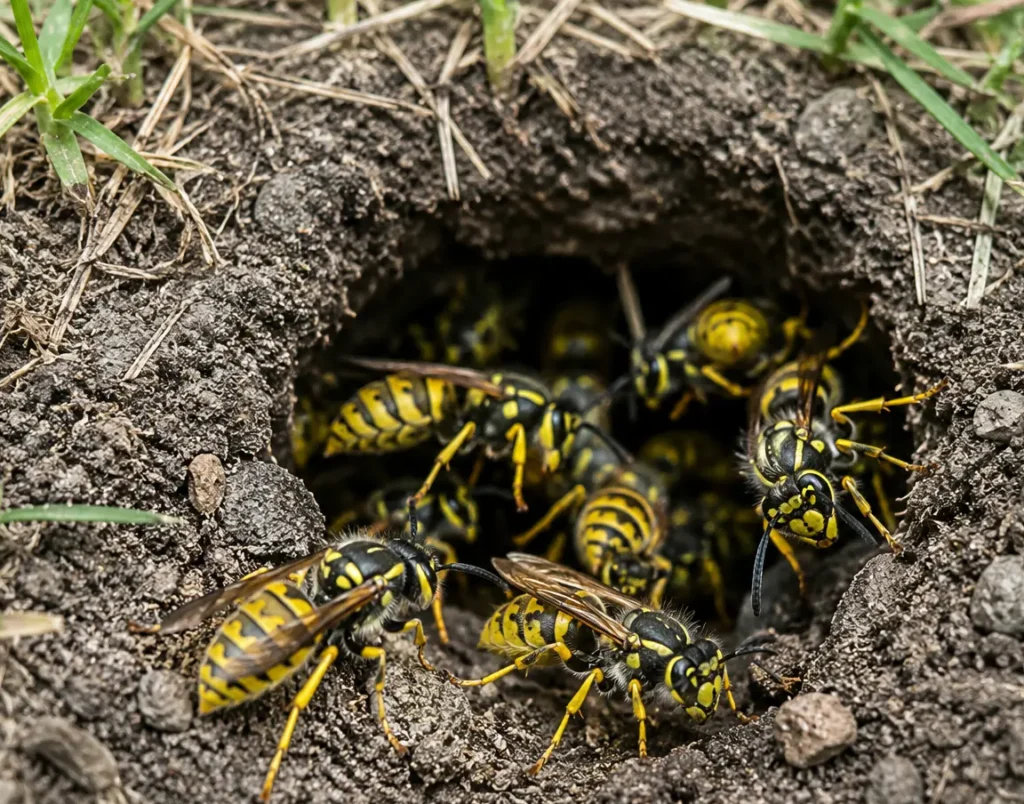
If you’ve ever been mowing the lawn on a hot August afternoon and had three or four wasps come up out of the grass at you, you already know what ground wasps are. You don’t need a diagram.
You need to know what you’re dealing with. How dangerous it actually is. And what to do about it without ending up in an emergency room.
We get calls about ground wasps every summer, almost always starting in July and running heavy through September. This guide covers what a homeowner in Toronto or anywhere in the GTA needs to know before deciding whether to handle it themselves or call someone in.
Quick summary if you’re dealing with this right now:
- Ground wasps in Ontario are almost always yellowjackets, not bees, hornets, or ants
- They nest in existing cavities in soil old burrows, gaps under decks, loose mulch beds
- Activity and aggression peak in late summer and early fall, not spring
- Small, isolated nests can sometimes be treated at night by a homeowner with the right precautions
- Nests near doorways, under structures, or in households with a known sting allergy are better left to a professional
- The colony dies off completely every fall the same hole is never reused, though a new queen may pick a similar spot next year
What Are "Ground Wasps," Exactly?
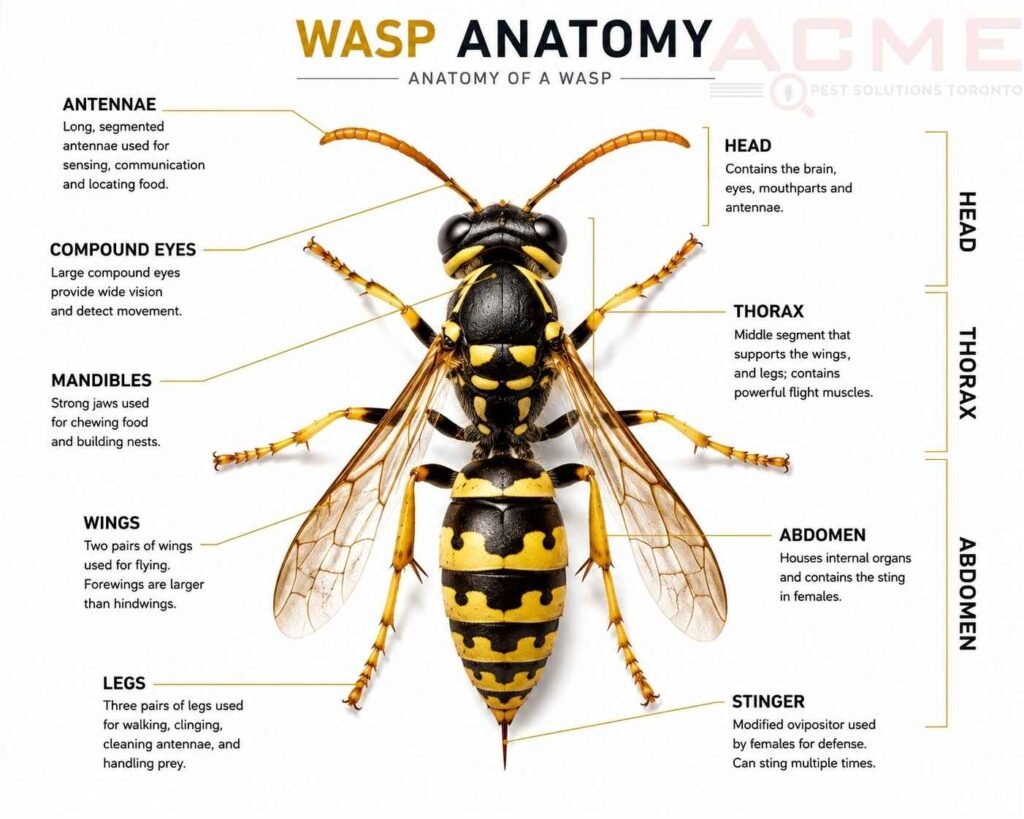
“Ground wasps” isn’t a species name. It’s what people call any wasp that nests underground instead of building the papery hanging nest most of us picture when we hear the word “wasp.”
In our part of Ontario, the wasp behind almost every ground nest we’re called out to inspect is the yellowjacket most commonly the Eastern yellowjacket or the German yellowjacket. Both are established across Ontario and are known for nesting in soil rather than up in a tree or under an eave.
One thing that surprises a lot of homeowners: yellowjackets rarely dig their own hole from scratch. They almost always move into an existing cavity, which is why the same handful of spots come up over and over during inspections:
- Old chipmunk or vole burrows
- Gaps under retaining walls or interlock stone
- Loose soil at the base of a shed or deck
- Voids left behind by a rotted-out tree root
- Abandoned mouse or mole tunnels near the foundation
That existing space gives them a head start on shelter, so if you’ve had any kind of small-mammal burrowing activity in your yard in past seasons, you’ve got a slightly higher chance of a colony moving in the following spring.
The nest itself is built from wood fibre the wasps chew up and mix with saliva, forming a paper-like material. Underground, the whole structure is protected by soil. What you see from the surface is just a small entrance hole, often no bigger than a coin, with wasps flying in and out in a fairly direct line.
How to Tell If It's Really a Ground Wasp Nest?
Before doing anything, you want to be sure you’re looking at an active wasp nest and not a mouse hole, a vole run, or an old abandoned burrow with no activity. Here’s how we sort that out during an inspection:
- Watch the traffic pattern. Wasps returning to a nest fly a fairly straight, repeated path to one specific point in the ground. A random ant or two wandering the lawn edge doesn’t mean much. Steady, repeated entry and exit from the same hole does.
- Check the time of day. Activity is usually heaviest on warm, sunny afternoons. Early morning and evening tend to be quieter, which is also why any removal work is best done at those times.
- Look at the entrance itself. Wasp entrances often have a slightly worn or bare patch of soil around them from the constant coming and going. Rodent burrows tend to have loose dirt kicked out in a small mound, and you won’t see flying insect traffic.
- Note the location. In our experience, the most common spots are lawn edges near flower beds, gaps in retaining walls and interlock, the base of sheds and decks, under bushes, and old compost piles. Anywhere soil is loose, undisturbed, and somewhat sheltered is fair game.
If you’re not confident in what you’re looking at, the safest move is to observe from several metres away rather than walking up to inspect the hole directly.
Why Ground Wasps Get More Aggressive Later in the Season?
This is a question we get constantly, usually from someone who got stung walking across their own backyard without any warning. The explanation comes down to colony biology, not bad luck.
Here’s roughly how a colony’s season plays out in Southern Ontario:
- Spring (April–May): A single overwintered queen starts the nest alone. The colony is tiny and easy to avoid without even knowing it’s there.
- Early summer (June): The first workers emerge and begin foraging. Activity is noticeable but the colony is still small and manageable.
- Mid-to-late summer (July–August): The nest can hold hundreds to a few thousand workers, all out foraging for protein to feed developing larvae. This is when nests become large enough to be a genuine risk.
- Early fall (September): Larval production slows, natural food sources decline, and the colony’s priorities shift toward defending itself and scavenging sugary food. This is when we see the most stings and the most service calls.
- First hard frost: The entire worker population dies off. Only newly mated queens survive, tucked into leaf litter or under bark, ready to start new colonies the following spring. The nest itself is never reused.
Late August and September calls make up the bulk of our ground wasp work for a simple reason: the colonies are at peak size, and the wasps are noticeably more defensive than they were in June.
Is It Safe to Remove a Ground Wasp Nest Yourself?
Sometimes, yes. But it depends heavily on the situation, and we’d rather be straight about the risks than pretend this is always a simple job.
Reasonable DIY situations:
- The nest is small, out in the open lawn, away from doors, walkways, and play areas
- Nobody in the household has a known wasp allergy
- You’re comfortable working at dusk when the wasps are least active
- You can maintain distance while treating the nest.
Situations where we’d strongly recommend calling a professional instead:
- The nest is close to a doorway, patio, deck, or anywhere people walk regularly
- There’s a known allergy to wasp or bee stings in the household
- The nest is large, judging by heavy, constant traffic
- The nest is hidden under a structure like a shed, deck, or retaining wall where treatment can’t reach the full colony
- You’ve already tried a DIY method and it didn’t work a partially disturbed nest is often more dangerous than one that’s never been touched
DIY Ground Wasp Removal Steps
If you’ve decided the nest is a safe candidate for DIY treatment, here’s what to have on hand before you start:
- Wasp-specific aerosol spray labelled for ground or crack-and-crevice use
- Long sleeves, long pants, closed shoes, and gloves
- A flashlight with a dim setting or a red-tinted cover
- Someone else aware of what you’re doing, in case anything goes wrong
- A clear escape path away from the nest, checked beforehand in daylight
And here’s the process we’d walk a homeowner through:
- Wait until evening or after dark. Wasp activity drops off significantly once the sun goes down, and most of the colony will be inside the nest rather than out foraging.
- Wear protective clothing. Long sleeves, long pants, closed shoes, and ideally something tucked in at the wrists and ankles. A pair of coveralls is worth having on hand if you’re doing pest work around your property regularly.
- Approach slowly and avoid shining a bright white light directly at the entrance, since sudden light and vibration can trigger a defensive response. A dim light angled off to the side works better than pointing a flashlight straight down the hole.
- Use a wasp-specific aerosol labelled for ground nests, applying it directly into the entrance according to the label instructions. Avoid pouring gasoline or other flammable liquids into the nest beyond being dangerous and a fire risk, it’s not a legal or environmentally sound method and it rarely eliminates the colony properly anyway.
- Leave the area immediately after treatment and avoid disturbing the site for at least 24 hours to let the product work through the colony.
- Recheck the next evening. If you still see wasps entering and exiting, the nest hasn’t been fully treated and needs a second application or professional follow-up.
- Fill the hole only after activity has completely stopped, not before, since sealing an active nest can force wasps to find another way out sometimes into your home through a foundation gap.
One mistake we see repeatedly: homeowners pour boiling water or soapy water into a hole during the day, thinking it’s gentler. It can work on very small nests. But daytime treatment means most of the colony is out foraging, and it simply returns to a nest that’s still functional — sometimes even angrier than before.
When to Call a Professional
We’ll be honest a lot of ground wasp jobs genuinely don’t need a technician. But there’s a point where the math stops favouring DIY, and it comes down to nest size, location, and personal risk tolerance.
After inspecting hundreds of properties across Toronto and the GTA, the pattern we see most often is a homeowner attempting a nest tucked under a deck or retaining wall, getting stung multiple times because they can’t reach the actual entrance, then calling us anyway. At that point, we’re dealing with an agitated colony instead of an undisturbed one.
A few clear signs it’s time to stop attempting this yourself and call in help:
- You’ve already been stung more than once trying to locate or treat the nest
- The entrance disappears under a structure and you can’t see where the tunnel actually leads
- Wasp traffic seems constant rather than occasional, suggesting a large, established colony
- Anyone in the home has a history of allergic reaction to stings
- A previous DIY attempt reduced activity but didn’t stop it entirely
If the nest is in a high-traffic area, close to where kids or pets play, or anyone in the house reacts strongly to stings, it’s simply not worth the gamble. A proper wasp removal service uses equipment and application methods that reach nests in wall voids, under structures, and other spots a store-bought aerosol can’t fully treat, and it’s done in a way that doesn’t put you in range of a defensive colony.
Ground Wasps vs. Other Backyard Stinging Insects
Homeowners often lump every stinging insect into one category, but the differences matter for figuring out the right approach:
- Ground-nesting yellowjackets build enclosed paper nests underground, are aggressive when the nest is disturbed, and are the most common cause of ground-level stings in Ontario yards.
- Bumble bees occasionally nest in small ground cavities too, but they’re far less aggressive, generally leave people alone unless the nest is directly stepped on, and play an important pollinator role in most cases these nests are better left alone or relocated rather than exterminated.
- Digger wasps and cicada killers create individual burrows in sandy or loose soil but are solitary insects, not colony-defenders, and are usually not a stinging risk to people at all despite their intimidating size.
If you’re not sure which one you’re looking at, that’s one of the more common reasons people call us. A quick photo or an in-person look settles it fast, and it changes whether the right move is removal or simply leaving the insects alone.
Getting It Handled Properly
Ground wasps are one of those problems that seem small right up until someone gets stung multiple times in a few seconds. That happens more often than people expect once a colony is disturbed.
If you’re dealing with a nest in a bad location, larger than you’re comfortable with, or you’ve already had a failed DIY attempt, it’s worth having it looked at properly rather than repeating the same approach and hoping for a different result.
As the best pest control company in Toronto for homeowners dealing with wasps, wildlife, and everything in between, Acme Wildlife Removal and Pest Control Toronto has spent years inspecting yards across the city and the surrounding GTA. Ground wasp nests are one of the most routine calls we handle every summer. If you’re unsure what you’re looking at, or you just don’t want to risk it, we’re glad to take a look.