

What Is an Ant?
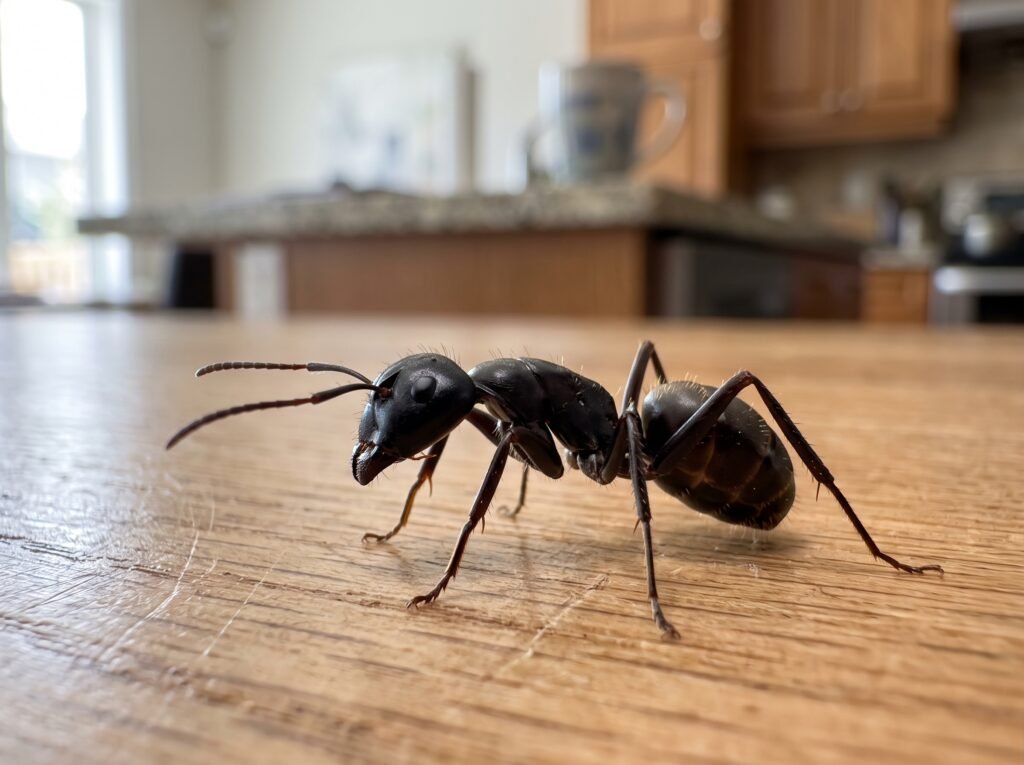
An ant is a social insect belonging to the family Formicidae, closely related to bees and wasps. Ants have six legs, a distinctly narrow, pinched waist called a petiole connecting the thorax to the abdomen, and bent, elbowed antennae. Canada is home to more than 100 recorded ant species, though only a handful regularly cause problems inside homes.
What kind of animal is an ant, exactly? Ants are insects, not arachnids or rodents, and like all insects, their bodies are divided into three main sections: head, thorax, and abdomen. What sets ants apart from most other insects homeowners deal with is their social structure. A single ant wandering across a countertop is never really alone. It represents a colony that could number anywhere from a few hundred to hundreds of thousands of individuals working together.
What Do Ants Look Like? Identification and Appearance
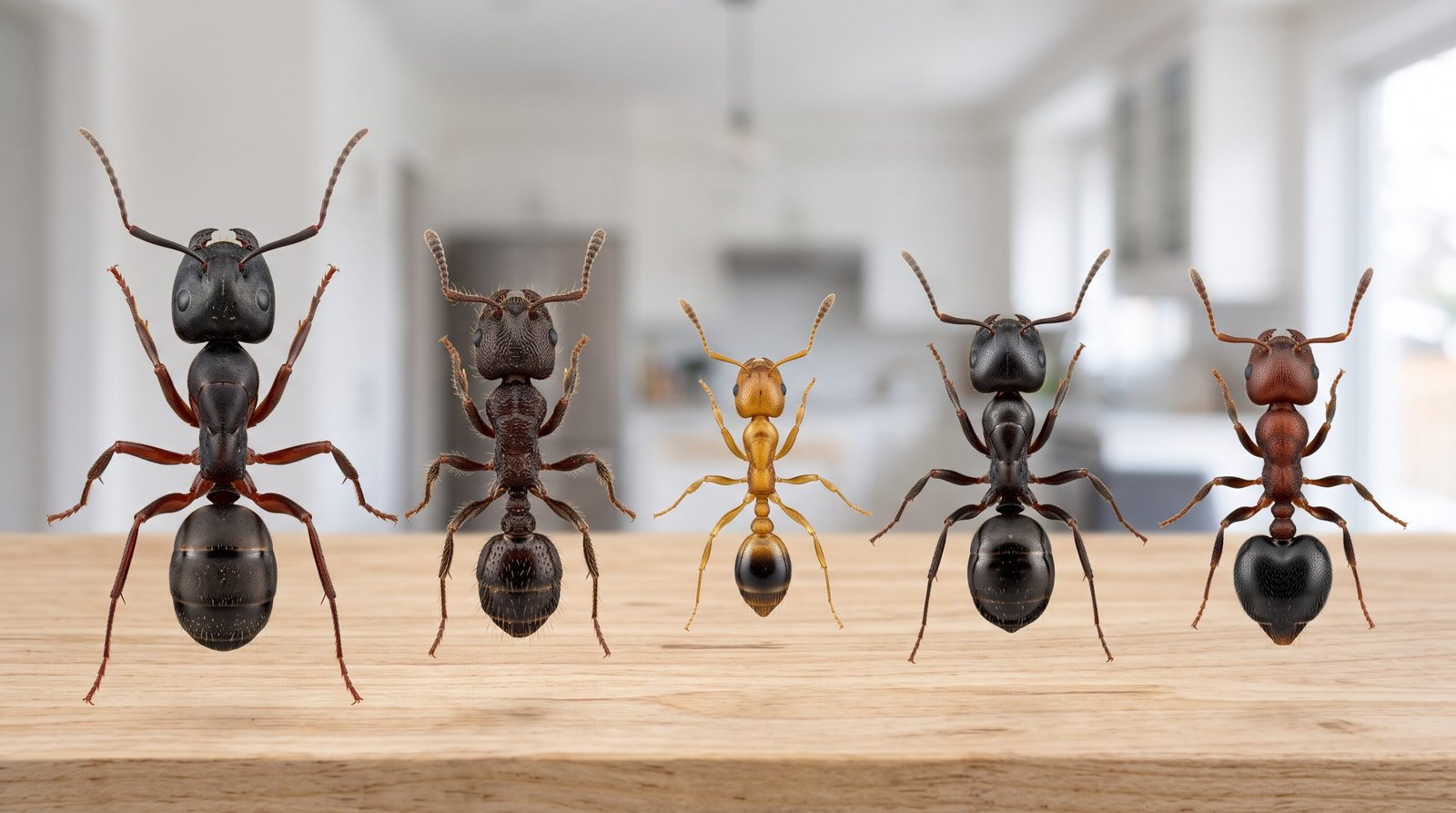
Ant appearance varies significantly by species, ranging in colour from black, deep brown, and red to yellowish-tan, and in length from about 1.5 mm up to 25 mm depending on the species and caste. Every ant has six legs and antennae, but only reproductive ants, queens and males, have wings, and only during specific periods of the year. Worker ants, the ones homeowners see foraging for food, are always wingless.
One thing we notice during inspections is how often homeowners assume a large ant means a large problem and a small ant means nothing to worry about. In our experience, it’s the opposite that’s often true. Some of the smallest ants, like the pharaoh ant, create the most persistent indoor infestations, while a handful of large carpenter ants can be the first visible sign of a colony that’s already caused real structural damage.
Common House Ant Species in Canada
The ants most likely to show up in a Toronto or GTA home fall into a few well-known categories, and correctly identifying which one you’re dealing with changes the entire treatment approach.
- Carpenter ant: The largest ant species found in Canada, ranging from about 6 to 25 mm, with red-and-black or all-black colouring. Carpenter ants don’t eat wood, but they excavate galleries inside moist or damaged wood to build their nests, and over time this tunnelling can cause genuine structural damage.
- Pavement ant: Small, brown to black, roughly 2.5 to 4 mm long, with two small spines at the rear of the thorax. True to their name, pavement ants nest under sidewalks, driveways, and foundation slabs, and often show up indoors searching for crumbs, particularly during colder months.
- Pharaoh ant: Tiny, around 2 mm, yellowish-brown to light red. Pharaoh ants nest indoors year-round in wall voids, behind baseboards, and under floors, and their colonies can split into multiple satellite nests, making them notoriously difficult to eliminate with over-the-counter products.
- Odorous house ant: Small, brown to black, around 3 mm, and named for the distinct, unpleasant smell they release when crushed, sometimes described as similar to rotten coconut. They nest in soil, under stones, mulch, or debris, and inside wall voids.
One mistake we see repeatedly is a homeowner treating carpenter ants the same way they’d treat pavement ants, using a surface spray on visible trails. Carpenter ants respond to an entirely different approach, since the goal is locating the nest itself rather than just the ants out foraging.
Where Do Ants Live? Habitat and Nesting
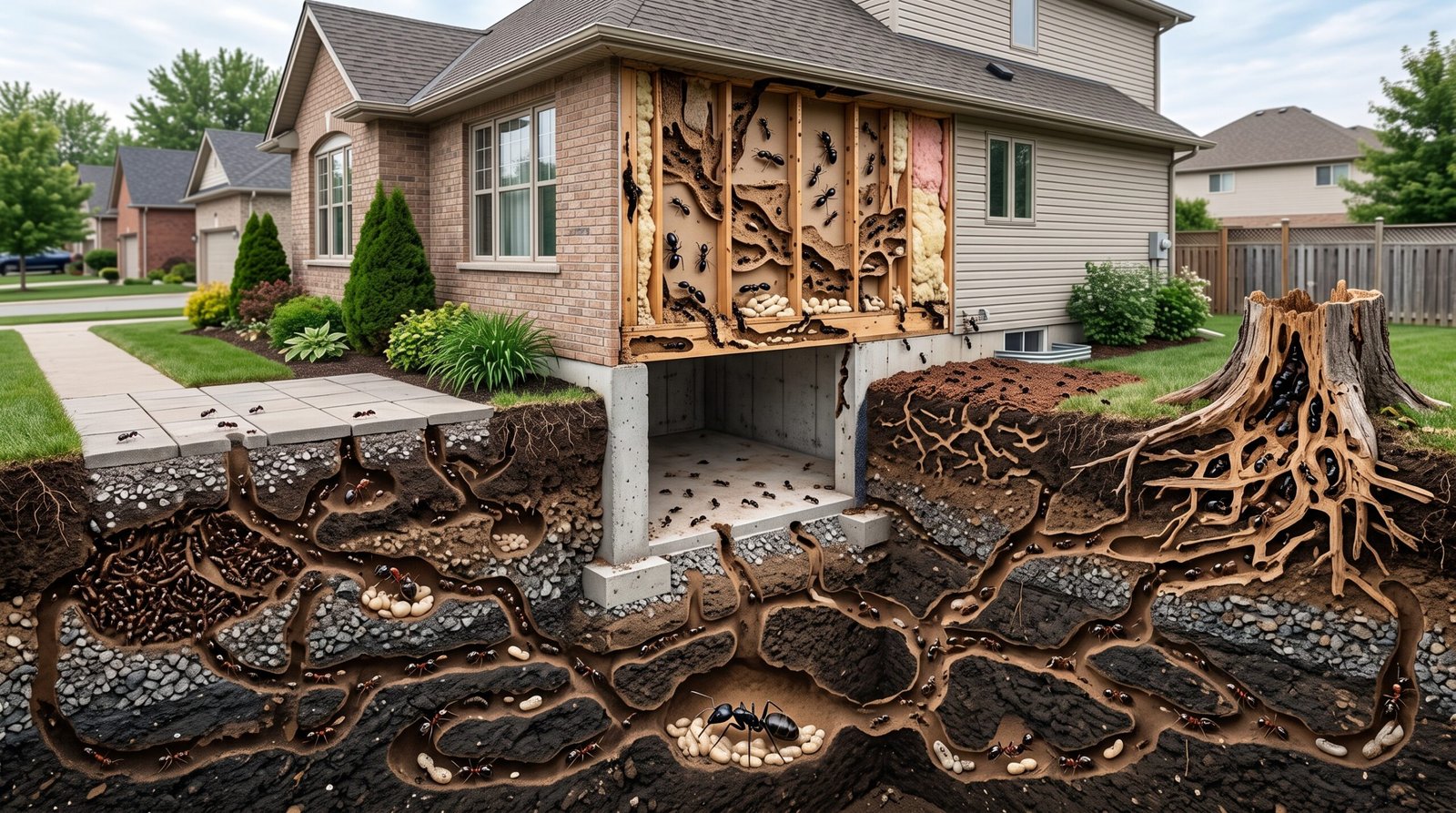
Ants build nests based on what their species needs, and knowing where to look changes the entire inspection.
- Carpenter ants nest in moist or water-damaged wood, including window frames, door frames, wall voids, roof boards, deck posts, and porch structures exposed to weather
- Pavement ants nest in soil beneath sidewalks, driveways, patios, and foundation slabs, often visible as small mounds of displaced dirt near cracks
- Pharaoh ants nest indoors almost exclusively, favouring warm, humid areas like kitchens and bathrooms, with colonies tucked into wall voids, behind baseboards, and under flooring
- Odorous house ants nest both outdoors under stones, logs, and mulch, and indoors within wall voids and beneath flooring, particularly near moisture sources
Most ant colonies build their nest in soil, though carpenter ants are the notable exception, tunnelling into wood instead. A single carpenter ant infestation can also include multiple satellite nests spread throughout a structure, which is exactly why finding and eliminating every nest is one of the more challenging parts of the job for a technician.
What Do Ants Eat?
Ants are opportunistic feeders, and their diet depends heavily on species, though most share a strong attraction to a few common food categories:
- Sugary foods, syrups, and sweets
- Proteins and greasy or fatty foods
- Meats and dead insects
- Crumbs, spills, and improperly stored pantry items
- Plant material, aphid honeydew, and other insects outdoors
Foraging worker ants are drawn indoors by nearly any food left accessible, and once a scout ant finds a reliable source, it lays down a pheromone trail that recruits the rest of the colony to follow the exact same path. This is why ant activity so often appears as a visible line rather than scattered individuals, and why wiping away a trail without addressing the food source or entry point rarely solves the problem for more than a day or two.
Ant Life Cycle and Colony Structure
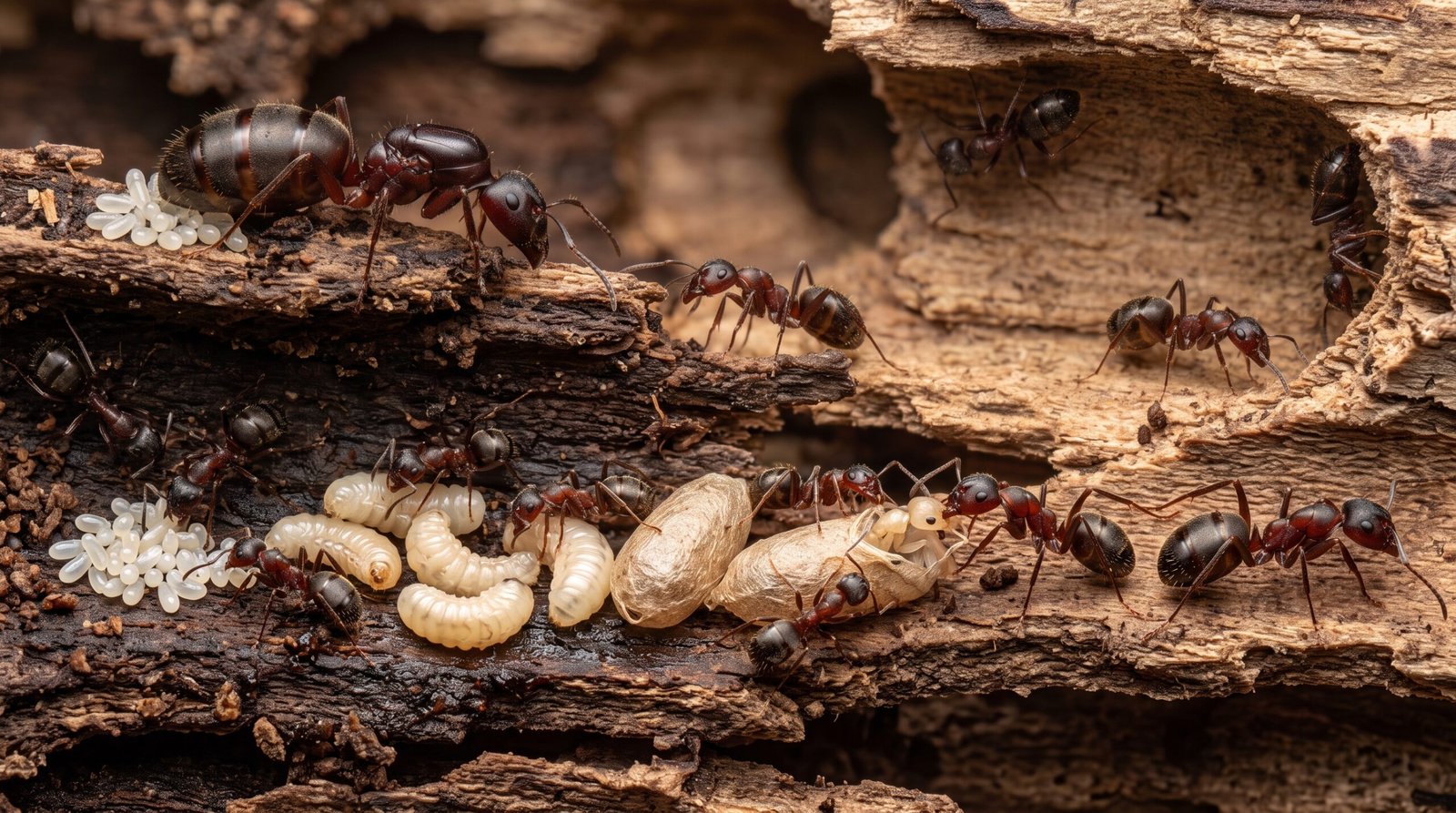
Ants develop through complete metamorphosis: egg, larva, pupa, and adult. A colony itself is organized into distinct castes, and understanding this structure explains why removing a few visible ants almost never resolves an infestation.
- Queen – Responsible for laying eggs and, through pheromone communication, directing much of the colony’s activity. Most colonies have a single queen, though certain species can have multiple queens supporting an even larger population.
- Workers – Sterile female ants that make up the vast majority of a colony, responsible for foraging, feeding larvae, maintaining the nest, and protecting the queen.
- Swarmers (reproductives) – Winged males and future queens produced during specific periods of the year. Swarmers leave the nest together, mate in flight, and the newly mated queens go on to establish new colonies elsewhere.
This changes depending on the species and the season. Carpenter ant swarms are most common in late spring and early summer, and seeing winged ants indoors during this period is often the first real sign of an established colony somewhere in the structure, since a swarm event typically only happens once a colony has matured enough to reproduce.
Ant Behaviour and Seasonal Activity
Ants communicate primarily through pheromones, using chemical trails to guide other workers to food, mark territory, and coordinate colony activity. This changes depending on the season. Warmer months bring a noticeable increase in outdoor foraging and visible trails, while several species, including pavement ants and odorous house ants, move indoors seeking shelter as temperatures drop in the fall. Pharaoh ants are the exception, since they nest indoors and remain active year-round in heated buildings regardless of the season outside.
Most homeowners are surprised to learn that a single ant seen wandering across a counter in winter is rarely a coincidence. It usually means an indoor colony, most likely pharaoh ants or an odorous house ant nest tucked into a wall void, has already been active through the cold months.
Signs of an Ant Infestation
Depending on the species, the physical evidence left behind can look quite different:
- Visible foraging trails, often following the same path along counters, baseboards, or exterior walls
- Small mounds of displaced soil near foundation cracks or driveway joints, typical of pavement ants
- Fine, sawdust-like debris (frass) near wall voids or window frames, a key sign of carpenter ant activity
- Winged ants indoors, particularly in spring or early summer, signalling a mature colony nearby
- A distinct, unpleasant odour when ants are crushed, characteristic of odorous house ants
- Slit-like openings in wood surfaces where carpenter ants are actively excavating
Our technicians usually discover that homeowners have been treating the same visible trail for weeks without success, simply because the nest itself was never located. Frass, in particular, is one of the clearest signs we look for, since it tells us carpenter ants are actively excavating nearby rather than just passing through.
Are Ants Dangerous to Humans?
Most ant species found in Canadian homes pose minimal direct risk to people. The majority of common house ants, including pavement ants and odorous house ants, rarely bite, and when they do, the reaction is typically mild. Carpenter ants can bite if provoked, and their mandibles are strong enough to break skin; some species can also spray formic acid into the bite, producing a burning sensation, though reactions vary and are generally mild.
The bigger concern with several species is contamination rather than injury. Pharaoh ants, in particular, are known to contaminate food and have been associated with carrying certain bacteria on their bodies as they move between unsanitary areas and food sources. Carpenter ants present a different kind of risk entirely: not to people, but to the structure itself, since ongoing excavation in wall voids, window frames, and support beams can lead to genuine, costly damage if left unaddressed. Their behaviour is often mistaken for termite damage, though the two are easy to tell apart once you know what to look for.
Carpenter Ants vs. Termites
Because both insects produce winged swarmers and both are associated with wood, carpenter ants and termites get confused constantly, especially in older homes. A few clear differences help sort them out:
- Carpenter ants have a narrow, pinched waist; termites have a thick, uniform waist with no visible narrowing
- Carpenter ant antennae are bent at an angle; termite antennae are straight
- Carpenter ant wings are unequal in length, with the front pair longer; termite wings are all the same length
- Carpenter ants push sawdust-like frass out of their nest; termites build mud shelter tubes and don’t remove debris the same way
Getting this right matters, since the treatment strategy for each pest is completely different. If you’re not confident which one you’re looking at, sending a photo to a professional before starting any treatment saves time and avoids wasted effort.
How to Prevent Ants
Prevention comes down to removing food access, moisture, and easy entry points:
- Clean up crumbs, spills, and grease promptly, especially on counters and floors
- Store food, including pet food, in sealed containers rather than original packaging
- Fix leaky pipes, faucets, and any sources of excess moisture, since this is a major draw for carpenter ants specifically
- Trim back trees and shrubs touching the exterior of the home
- Seal cracks in foundation walls, and gaps around windows, doors, and utility penetrations
- Stack firewood away from the house and off the ground, inspecting it before bringing any indoors
- Clean gutters and downspouts regularly to prevent water damage that attracts carpenter ants
We’ve found that addressing moisture issues resolves more carpenter ant problems long-term than any spray or bait ever could, since a colony that’s lost its damp wood source has no reason to stay.
How to Get Rid of Ants
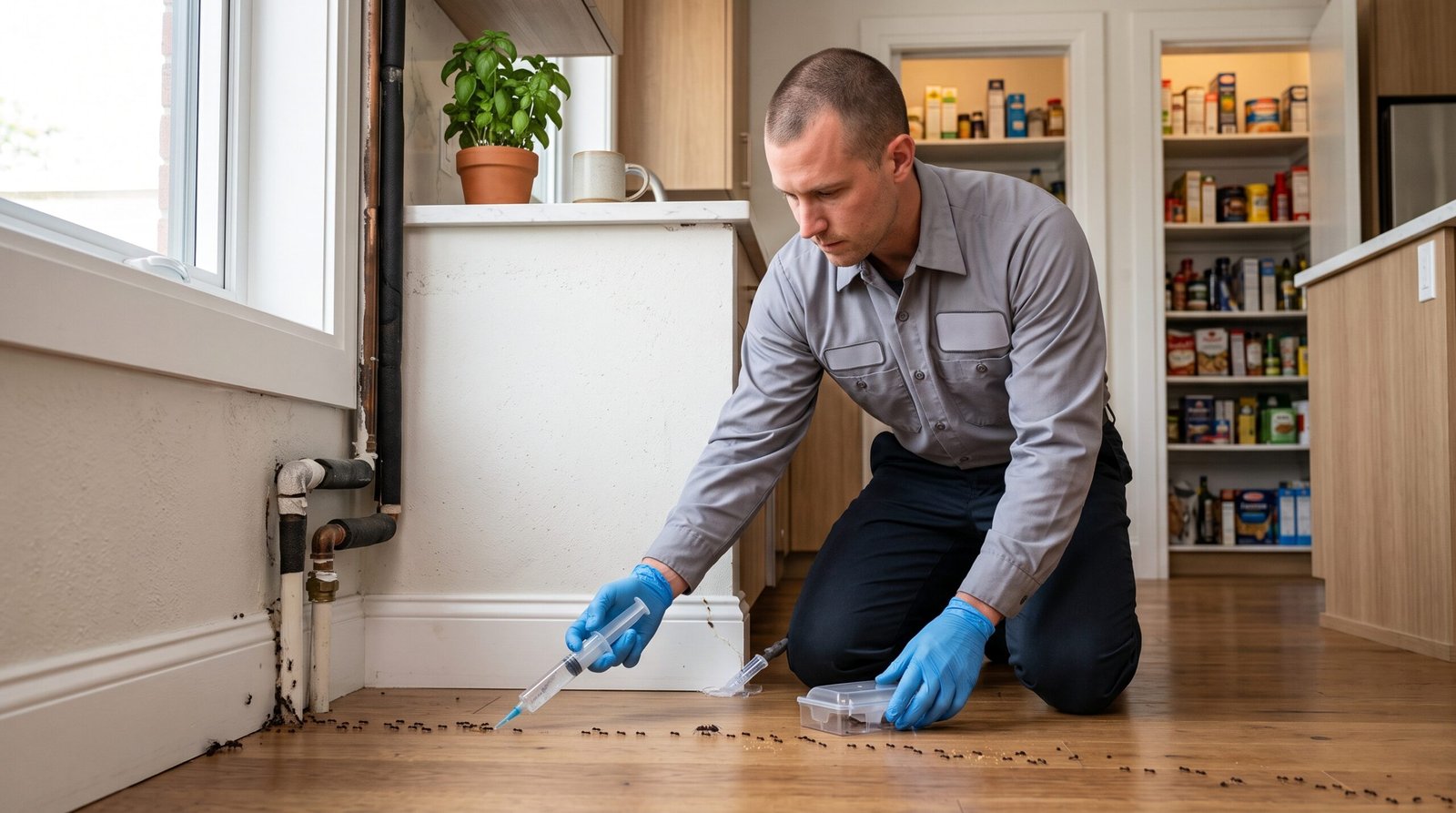
Bait stations – Generally the most effective approach for most ant species, since foraging workers carry the bait back to the colony, where it spreads to the queen and larvae through normal feeding and grooming. This is particularly important for species like pharaoh ants, where disturbing a colony with the wrong product can cause it to split into multiple satellite nests.
Trail treatment – Following an ant trail back toward its source helps identify where a colony is entering the home, which is far more useful than treating the visible trail alone.
Perimeter treatment – Applied around the foundation, this creates a barrier that helps prevent outdoor colonies, like pavement ants and odorous house ants, from establishing new entry points into the home.
Nest excavation and treatment – For carpenter ants specifically, locating the actual nest, often guided by frass piles and sound evidence within a wall void, allows for targeted treatment directly at the source rather than just addressing foraging ants.
DIY vs. Professional Ant Control
This is one area we’re upfront about. Store-bought sprays kill the ants they contact but do nothing for the colony behind them, and in the case of pharaoh ants, an aggressive spray can actually cause the colony to “bud” into several new, harder-to-find nests. Carpenter ants require locating the nest itself, which often means checking areas most homeowners wouldn’t think to inspect, like porch posts, window sills, and roof boards exposed to weather. Our technicians usually discover that a homeowner’s DIY attempt bought a temporary lull in activity rather than an actual solution, with ants returning within a few weeks once the colony recovers.
Professional Ant Removal
A proper ant inspection starts with identifying the exact species, since carpenter ants, pavement ants, pharaoh ants, and odorous house ants all require different treatment strategies based on where they nest and how their colonies are structured. Our pest control services combine species identification, targeted baiting, and exclusion work to seal entry points, along with nest location for carpenter ant infestations where structural wood is involved.
If you’re finding ant activity alongside other pest signs, whether that’s spiders hunting nearby insects or termite-like wood damage you’re not sure how to identify, it’s worth having a broader home and wildlife inspection done at the same time to rule out overlapping issues.
Frequently Asked Questions
What kind of animal is an ant?
An ant is an insect, not an arachnid or rodent, with a three-part body, six legs, and antennae, though only reproductive ants develop wings.
Are ants harmful to humans?
Lorem ipsum dolor sit amet, consectetur adipiscing elit. Ut elit tellus, luctus nec ullamcorper mattis, pulvinar dapibus leo.
How do I get rid of ants in my house?
Identify the species first, since treatment differs significantly between them. Bait stations that let workers carry treatment back to the colony are generally more effective than surface sprays, and carpenter ant infestations typically require locating and treating the nest directly.