

I’ll be upfront with you: I’ve been on the receiving end of a skunk spray. Not once, but three times over twenty years of wildlife removal work across the GTA. The first time was under a deck in Brampton on a humid July evening. The second was a near-miss in a crawlspace in Scarborough. The third the worst, was when a striped skunk I was relocating from a Mississauga property turned around faster than I anticipated. I know exactly what you’re going through right now, and I know precisely what works and what doesn’t.
The good news is that skunk odour is completely removable from your dog, your clothes, your house, and your car when you use the right approach and act quickly. The bad news is that most of the advice circulating online is either incomplete, chemically incorrect, or will actively make things worse. Let me cut through all of it.
Why Skunk Smell is So Difficult to Remove — The Chemistry Explained
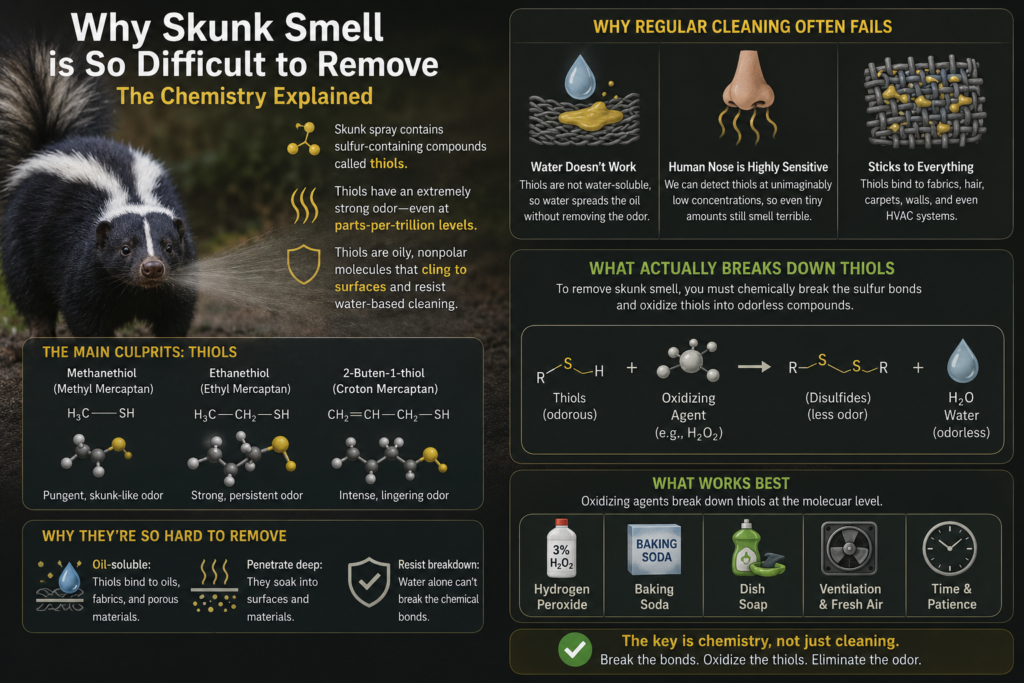
Before you can effectively remove skunk odour, you need to understand what you’re actually dealing with. Skunk spray isn’t just a bad smell, it’s a precisely engineered chemical defence system, and treating it like ordinary odour is why so many home remedies fail.
The spray itself is an oily, yellow-tinted secretion expelled from the anal glands of the striped skunk (Mephitis mephitis) the species found across Ontario and the GTA. Skunks can spray accurately up to 4.5 metres, and the musk vaporises rapidly on contact, permeating porous surfaces within seconds. The human nose can detect it in concentrations as low as 1 part per 10 billion, which is why even a trace amount left untreated can linger for weeks.
Skunk musk is composed of seven chemical compounds. Six of them are sulfur-containing thiols, the same class of compounds that makes rotten eggs smell. Thiols react immediately and produce that instant blast of acrid odour. The seventh compound is a group of thioacetates, which are far more insidious. Thioacetates are relatively odourless at first, but when they come into contact with water or high humidity, they convert back into smell-producing thiols. This is the chemical reason why:
Skunk smell seems to return after your dog gets wet weeks later.
Treated clothing smells fine until it’s washed again.
A treated room smells better for days, then intensifies when it rains.
In the GTA, this is a particularly relevant issue. Our humid summer weather, especially August and September, when temperatures stay warm and humidity is high means that inadequately treated skunk odour will reliably reactivate. I’ve responded to calls from homeowners in Vaughan and North York who were convinced a new skunk had sprayed under their deck, only to discover the original spray from three weeks prior had simply been reactivated by two days of rain. Understanding thioacetates is the key to avoiding this frustration.
The effective solution, discovered by chemist Paul Krebaum in 1993, works by oxidising the thiols into sulfonic acids, odourless compounds that have no smell. This is a genuine chemical transformation, not masking. This is why the Krebaum formula works when nothing else does.
The Tomato Juice Myth: Tomato juice does not remove skunk smell. It never has. What actually happens is olfactory fatigue, your nose becomes so overwhelmed by skunk odour that it temporarily stops registering it. When you introduce the strong scent of tomato, your nose “smells” that instead, creating the impression the skunk smell is gone. The same is true of beer, oatmeal, and citrus juice. These mask, they do not neutralise
The Krebaum Formula: The Only Scientifically Proven Skunk Smell Remover
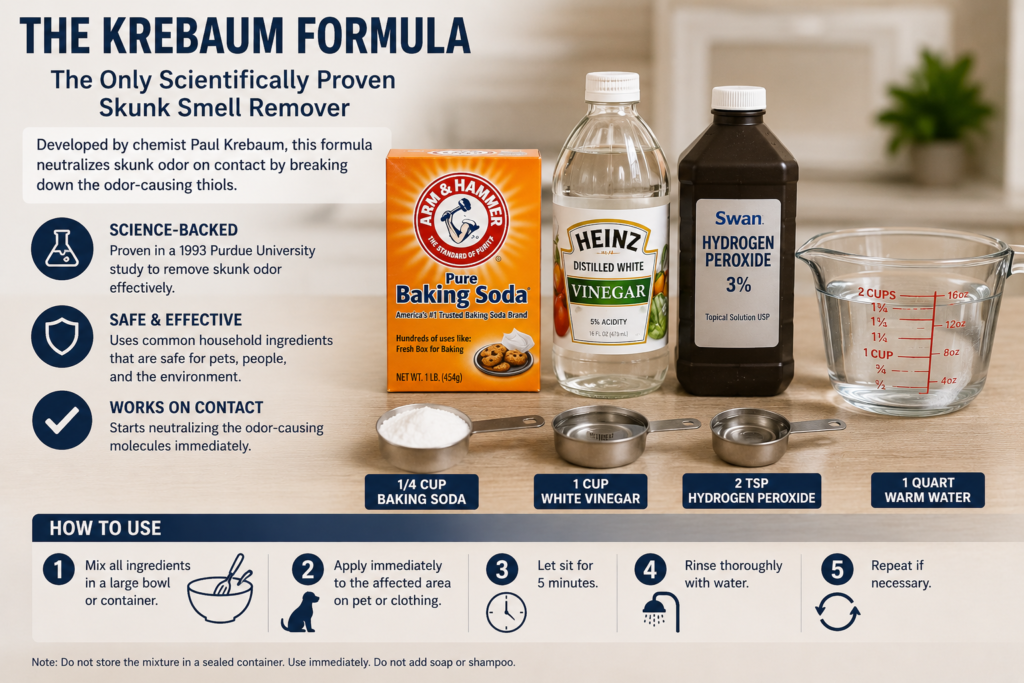
Every wildlife professional I know, including my own team at Wildlife Removal Toronto, keeps the ingredients for this formula on hand at all times. It is the only solution that has been chemically proven to neutralise skunk odour, and the ingredients cost under $10 at any Canadian grocery or drug store.
Krebaum Formula — Mix Fresh Each Time, Never Store:
1 litre (1 quart) 3% hydrogen peroxide
60 ml (¼ cup) baking soda
5 ml (1 teaspoon) liquid dish soap (Dawn or any grease-cutting soap)
CRITICAL SAFETY WARNING: Mix in an open container only. The reaction produces oxygen gas , a sealed container or a closed spray bottle will pressurise rapidly and can explode. Use immediately and discard any unused portion outdoors.
For pets and humans, avoid contact with the eyes and mouth , hydrogen peroxide can cause severe corneal irritation. Also, be aware that hydrogen peroxide will temporarily lighten dark or black fur to a bronze tone; this fades naturally as new fur grows out.
How to Get Rid of Skunk Smell on a Person
If you are the one who took the direct hit, your immediate actions determine how long that smell stays bonded to your skin.
1. Do Not Take a Hot Shower First
This is the most common mistake. Hot water opens up your skin pores and thins the skunk’s oily musk, allowing it to penetrate deeper into your dermal layer. Always start with lukewarm or cool water.
2. Wash with Grease-Cutting Soap
Standard body washes are designed for sweat, not heavy industrial-grade oils. Use a grease-cutting dish soap (like Dawn) or a heavy-duty mechanic’s soap to break down the oil bond on your skin before switching to normal soap.
3. Apply the Peroxide Formula to Hair
If the spray hit your hair, wash it using the fresh Krebaum formula mixed in an open bowl. Work it thoroughly into your hair and scalp, let it sit for no more than 3 to 5 minutes, and rinse thoroughly with cool water. Keep your eyes tightly shut.
How to Get Rid of Skunk Smell on a Dog
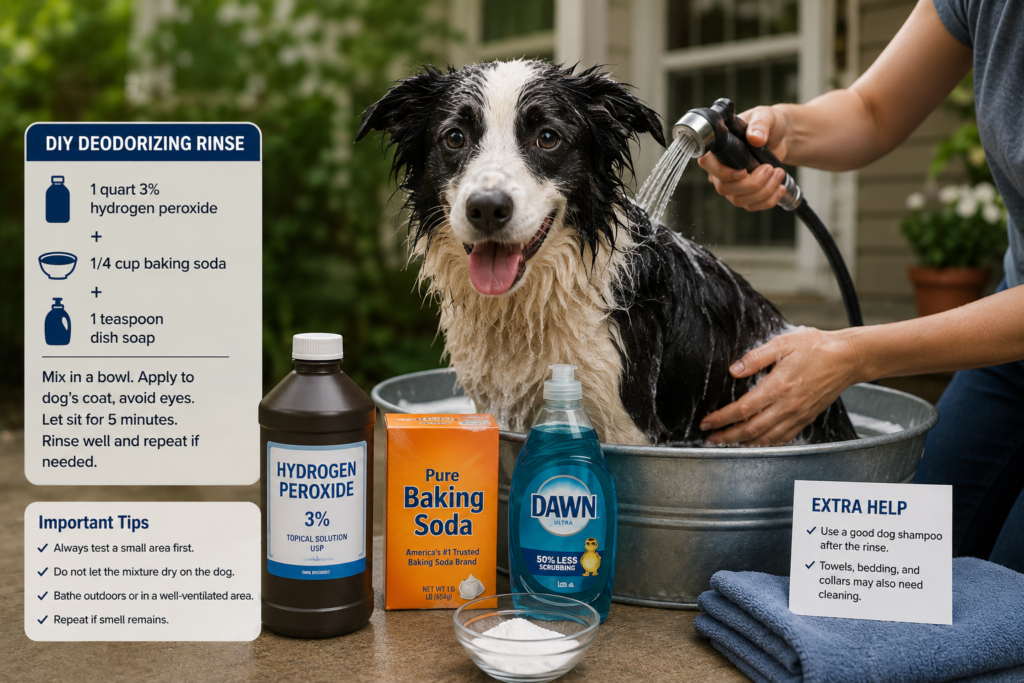
This is the scenario I hear about most often, and the one where the first five minutes matter most. A dog that has been sprayed and brought indoors will transfer the oily skunk musk to every fabric surface it contacts: the carpet, the sofa, the bed, and your clothing. I’ve assessed homes in Etobicoke and Pickering where the dog was brought inside immediately, and the odour remediation took three times longer as a result.
Keep the dog outside: Do not let it into the house, car, or garage. If it’s cold, prepare the treatment as quickly as possible and work in a well-ventilated space like an open garage.
Remove accessories: Take off the dog’s collar and tags immediately and place them in a sealed plastic bag to treat separately or discard.
Pat, do not rub: Pat the affected fur with a dry paper towel to absorb excess oily musk before applying any water. Rubbing spreads the oil deeper into the coat and skin.
Apply the formula: Apply the Krebaum formula down to the skin. Leave it for five minutes, then rinse with cool water. Repeat until the odour is neutralised.
Shampoo finish: Follow up with regular dog shampoo to remove the physical oiliness that persists independently of the smell.
Veterinary Warning: If your dog was sprayed in or near the face, watch closely for eye redness, squinting, drooling, or vomiting. In rare but serious cases where a dog has been heavily sprayed in the face, Heinz body anaemia (methemoglobinemia) can develop within 24 hours. This is a dangerous blood condition requiring immediate veterinary care. Monitor your pet for 24 to 48 hours post-exposure.
Commercial products like Nature’s Miracle Skunk Odour Remover and Skunk-Off are readily available at PetSmart and Pet Valu locations across the GTA. These are enzymatic cleaners that break down odour-causing compounds biologically and work well if hydrogen peroxide isn’t on hand.
How to Get Rid of Skunk Smell in Your House
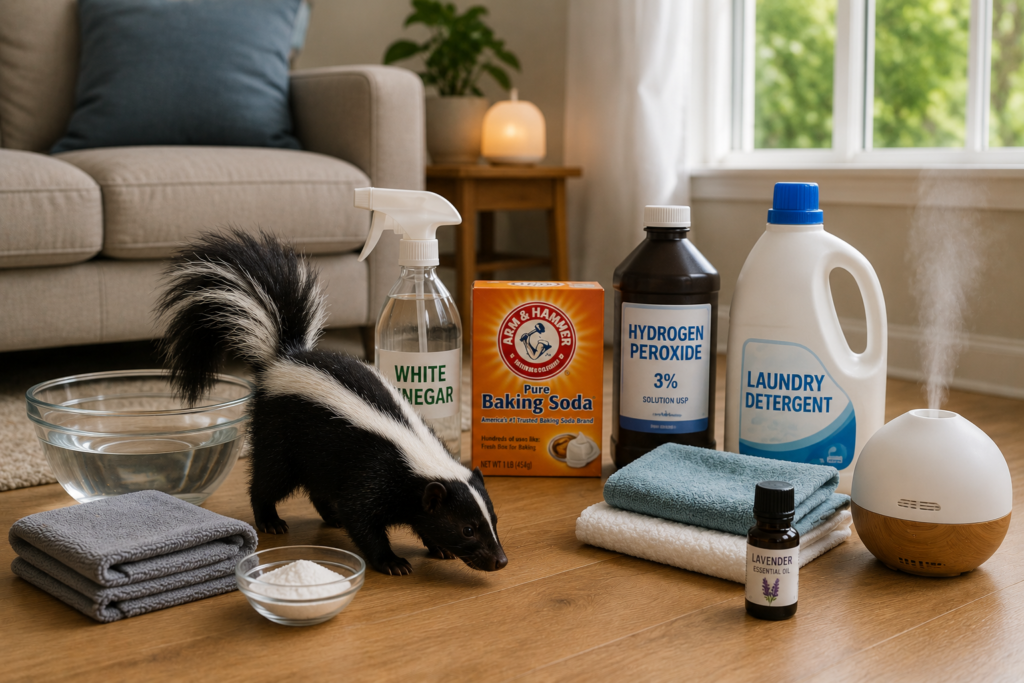
A skunk that sprays under a porch, deck, or near a basement window can fill an entire home with odour within minutes. Homeowners wake up at 2 a.m. to a house that smells like the skunk is sitting in their living room. In most cases, the smell has infiltrated through foundation vents, window frames, or the HVAC system.
Immediate Steps for Home Remediation
Air Circulation and Ventilation
Ventilate immediately. Open every window and door you can. Run ceiling fans in the opposite direction (pushing air out, not down) to create cross-ventilation and push skunk-saturated air out of the structure.
White Vinegar Bowls
Place bowls of white vinegar in every room, including the basement. White vinegar absorbs ambient odour compounds from the air as a mild acid that reacts with and neutralises alkaline odour molecules. Replace every 24 hours until the smell subsides.
CHEMICAL WARNING: Do not mix the white vinegar and baking soda together in these bowls. Acid and bases neutralise each other on contact, leaving you with fizzing water that has zero odour-absorption power. Use them completely separately.
HVAC Filter Replacement
Check and replace your HVAC filter immediately. If your forced-air system was running when the spray occurred, skunk compounds have been drawn through the return air and deposited on your furnace filter. Running the system without replacing the filter will continue to circulate skunk odour throughout the house.
Carpet and Upholstery Treatment
Treat fabrics with an enzymatic cleaner designed for organic odours. Spray lightly, do not saturate and allow to dry fully. For heavily affected areas, Nisus Bac-Azap is a commercial-grade enzymatic deodoriser available through janitorial supply stores in the GTA.
Hard Surface Cleaning
Treat hard surfaces (tile, wood, concrete) with a 90% water / 10% bleach solution. For unfinished wood, common in basement framing and crawlspace joists, a diluted bleach wipe followed by thorough drying works well. Do not use ammonia-based products on any surface; ammonia intensifies the perception of sulfur-based odours.
The Humidity Warning
In GTA summers, even after successful odour treatment, you may notice the smell returning on humid days. This is the thioacetate-to-thiol conversion at work, residual compounds reactivating in high moisture conditions. If this happens, repeat the vinegar bowls and enzymatic treatment.
How to Get Rid of Skunk Smell on Clothes
Clothing that has been hit directly by skunk spray is genuinely difficult to save. If the garment is inexpensive, discarding it is the practical choice. But for clothing worth keeping, use this process:
Isolate immediately: Do not put sprayed clothing in your laundry basket or hamper with other items. Place immediately in a sealed black plastic bag and keep outside until you’re ready to treat it.
Pre-soak: Pre-soak in a mixture of laundry detergent and 125 ml (½ cup) of baking soda in the hottest water safe for the fabric. Soak for at least 30 minutes before washing.
The wash cycle: Wash with regular detergent using the hottest setting safe for the fabric. Add another ½ cup of baking soda to the wash cycle.
Air dry, never machine dry: This is one of the most important and least-known steps. Machine drying bakes any residual thiols permanently into the fabric fibres. If even a trace of odour remains after washing, the dryer will set it irreversibly. Hang the garment outdoors in direct sunlight, which provides additional UV-based odour breakdown.
How to Get Rid of Skunk Smell in Your Your Car
Cars are particularly challenging because they combine multiple surface types and the enclosed space concentrates odour effectively. If you drive over a roadkill skunk, the musk is typically on the undercarriage and wheel wells but gets drawn into the cabin through the fresh air intake.
Wash the undercarriage: Wash the exterior thoroughly, paying particular attention to the undercarriage, wheel wells, and the fresh air intake at the base of the windshield. Use a grease-cutting car wash solution.
Solar baking: Air out the interior with all windows and doors open for as long as possible. If parked in the sun on a warm GTA summer day, heat will accelerate the off-gassing of odour compounds from the interior materials.
Upholstery misting: Treat upholstery and carpet with white vinegar in a spray bottle — mist lightly, do not saturate, and allow to dry with windows open. Follow with an enzymatic cleaner once dry.
Change the cabin filter: Replace the cabin air filter. If your vehicle’s fresh air system was on when the encounter occurred, the cabin filter will have trapped odour compounds and will continue to distribute them through the vents.
Activated charcoal adsorption: Place activated charcoal bags in the vehicle overnight for three to five nights. Activated charcoal is highly porous and physically adsorbs residual odour molecules from enclosed air. These are available at hardware stores and Canadian Tire locations across the GTA
Skunk Smell That Keeps Getting Stronger — The Dead Skunk Problem
This is a scenario I want to address specifically because it catches homeowners completely off guard. If you’ve treated a skunk odour event thoroughly and the smell is consistently intensifying rather than fading over one to two weeks, especially if it appears to be coming from a specific area like under the deck, from the crawlspace, or along the foundation, there is a strong possibility the skunk has died on your property.
A dead striped skunk continues to emit musk from its decomposing scent glands for days to weeks after death. The smell from a decomposing skunk is a combination of skunk musk and organic decomposition, a distinctly different and more complex odour than a fresh spray. Ventilation and enzymatic cleaners will not resolve it. The carcass needs to be physically located and removed.
In twenty years of GTA work, I’ve retrieved dead skunks from under decks in Markham, from inside basement wall cavities in Scarborough, from beneath concrete front porches in North York, and from crawlspaces in Ajax and Pickering. Locating the carcass, especially when it has crawled into an enclosed space to die, requires specialised equipment and experience. This is something our team at Wildlife Removal Toronto handles with full protective gear, and it’s not a job I’d recommend taking on alone.
How to Prevent Skunk Smell from Happening Again
Once you’ve dealt with a skunk odour event, the next step is wildlife management. Skunks in the GTA are most active from April through October, with peak activity in May through August when breeding season drives males to expand their range, and juveniles disperse in late summer.
The most effective prevention steps, in order of importance:
| Prevention Measure | Why It Works |
| Secure all garbage and green bin lids | Food is the primary driver of urban skunk presence. The GTA’s organic waste program is a reliable skunk attractant. Use locking lids or store bins in an enclosed garage overnight. |
| Remove accessible compost & pet food | Outdoor compost heaps and pet food bowls left outside overnight are consistent skunk attractants. Move compost to a sealed container; bring pet dishes in at sunset. |
| Install motion-sensor lighting | Skunks are nocturnal and dislike sudden bright light. A motion-activated light over deck areas, along fences, and near garden beds disrupts their foraging patterns. |
| Exclude under-deck & porch spaces | Skunks den under decks, porches, and sheds. Installing heavy-gauge hardware cloth around the perimeter, angled outward underground to prevent digging, removes the denning option entirely. |
| Trim low vegetation and brush piles | Dense low ground cover provides daytime shelter. Removing brush piles and keeping vegetation trimmed back from the foundation reduces habitat attractiveness. |
If you have a recurring skunk presence on your property, the underlying issue is almost always an active den site on or very near your property. Finding and humanely excluding that den is the permanent solution. At Wildlife Removal Toronto, we locate active skunk dens across Mississauga, Brampton, Vaughan, Scarborough, North York, Etobicoke, Markham, Ajax, and Pickering, and we install professional-grade exclusion that prevents re-denning without harming the animal.
Frequently Asked Questions
How long does skunk smell last if untreated?
Untreated skunk odour can persist for two to three weeks on outdoor surfaces and up to a month or longer on porous indoor materials like carpet, upholstery, and clothing. The thioacetate compounds in skunk musk convert back into odour-producing thiols when exposed to water or humidity, which means the smell can seem to disappear and then return repeatedly during humid GTA weather
Does tomato juice get rid of skunk smell?
No, this is one of the most persistent myths in wildlife removal. Tomato juice does not chemically neutralise the sulfur compounds in skunk musk. What it creates is olfactory fatigue — your nose becomes so saturated with skunk odour that it temporarily stops registering it, and when the new scent of tomato is introduced, your brain interprets that as the smell being gone
Can skunk smell come through HVAC vents?
Yes, and this is one of the most under-discussed aspects of the indoor skunk smell problem. If a skunk sprays near a fresh air intake or foundation vent, and your forced-air system is running, the HVAC will draw skunk compounds into the system and distribute them throughout the house via the ductwork. The first step is to turn off the HVAC and replace the furnace filter.